

To understand where the future is headed, we can better prepare for it. As William Gibson famously put it, “The future is already here. It’s just not evenly distributed.” With AI, the possibilities can feel limitless. What holds us back may not be what AI cannot do, but what we have not yet imagined.
So how do we prepare for the future? How do we get “back to the future”? What will companies and organizations actually look like, and who should we become to live and work within them?
I started writing this article because I wanted a framework for thinking about future organizations. We talk about “AI native companies” as if we will immediately recognize them when they arrive. But if the future is already here and unevenly distributed, how do we spot a company that is building toward it now?
I do not have the answer yet. This is my attempt to find a way of looking.
Three Relationships
I think we can examine a future organization through three relationships:
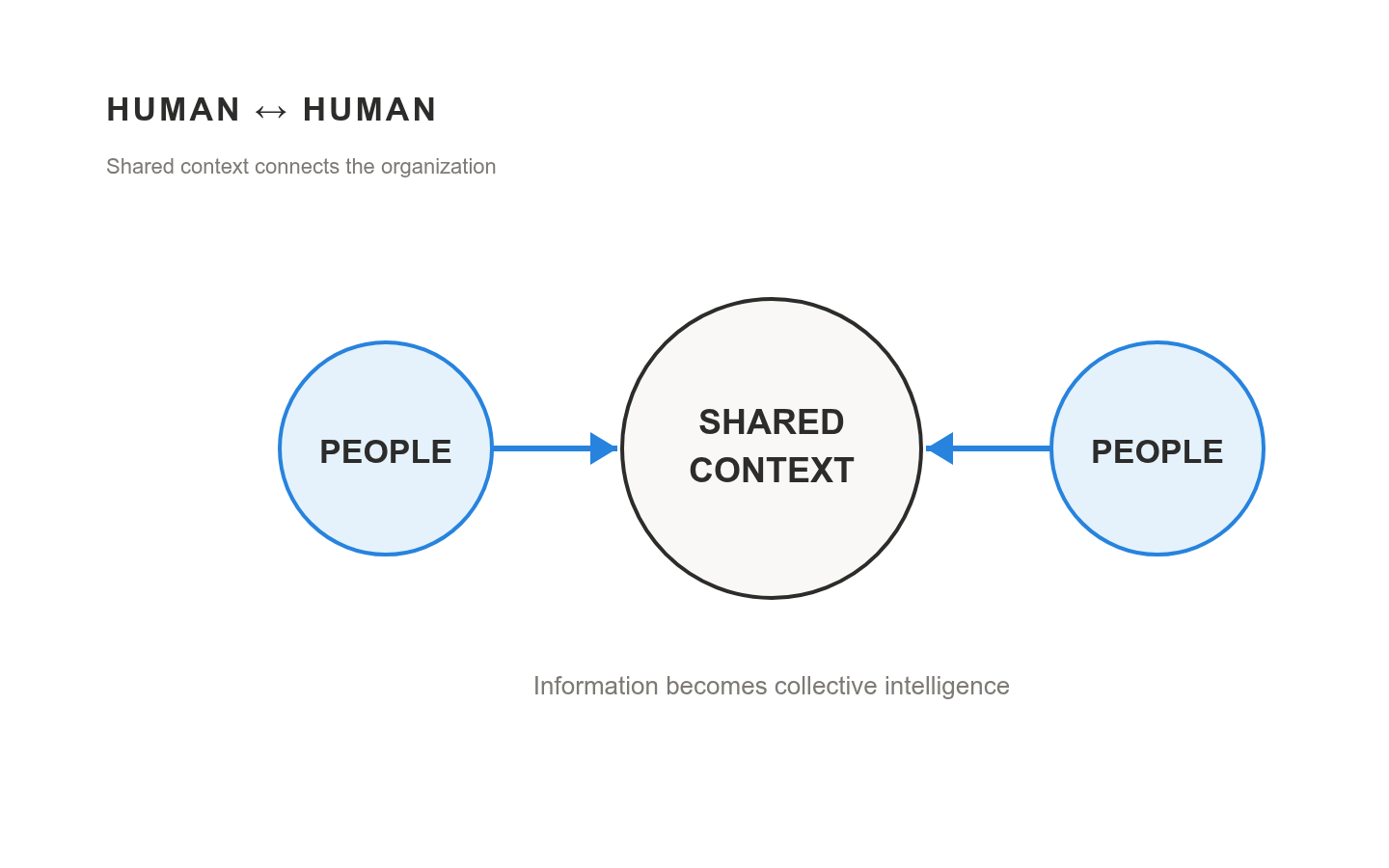
Human ↔ Human: How is the organization composed? How do people interact, share information, coordinate, and make decisions?
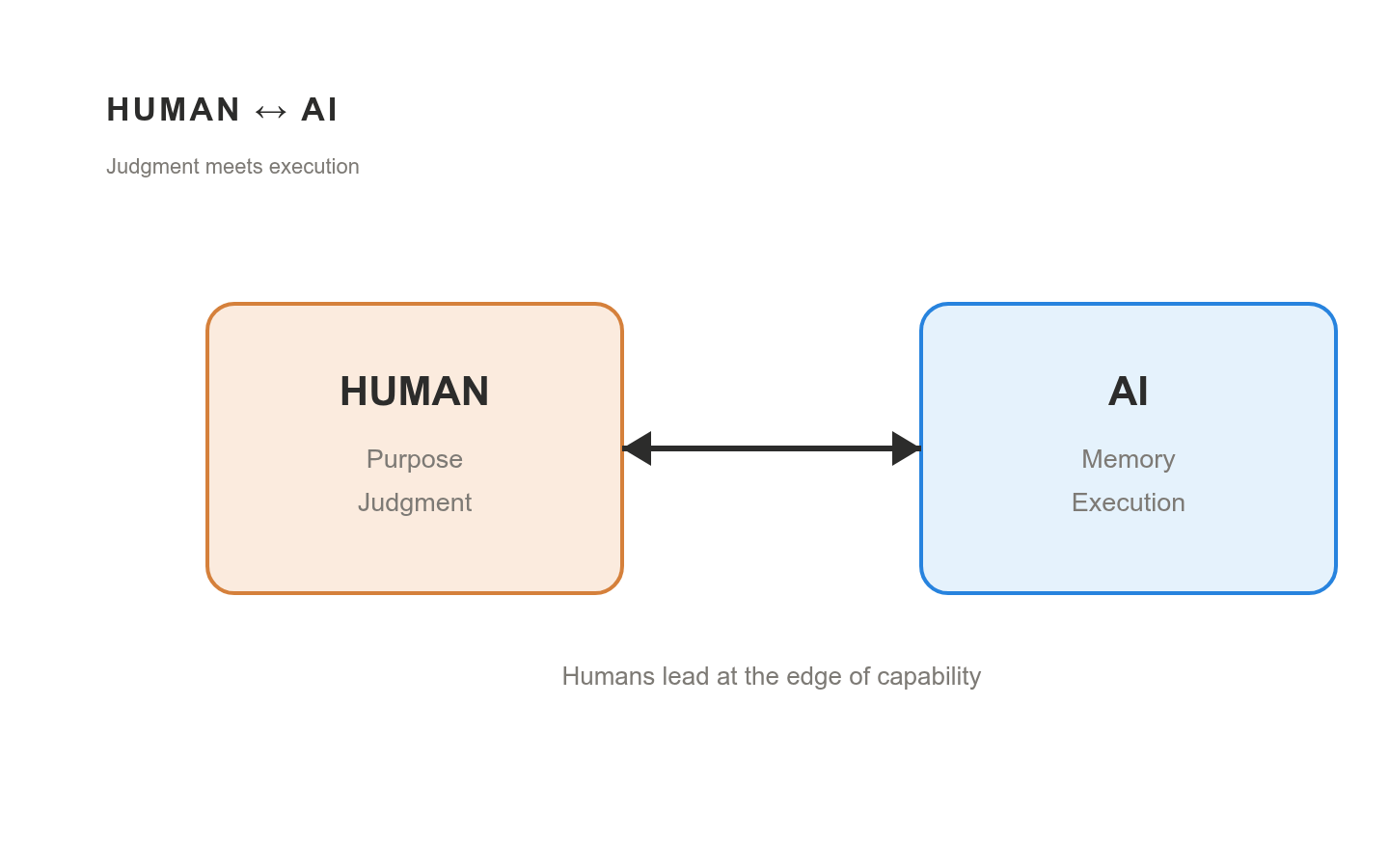
Human ↔ AI: How do people work with AI? Is AI simply a tool, or does it become part of the organization’s operating intelligence?
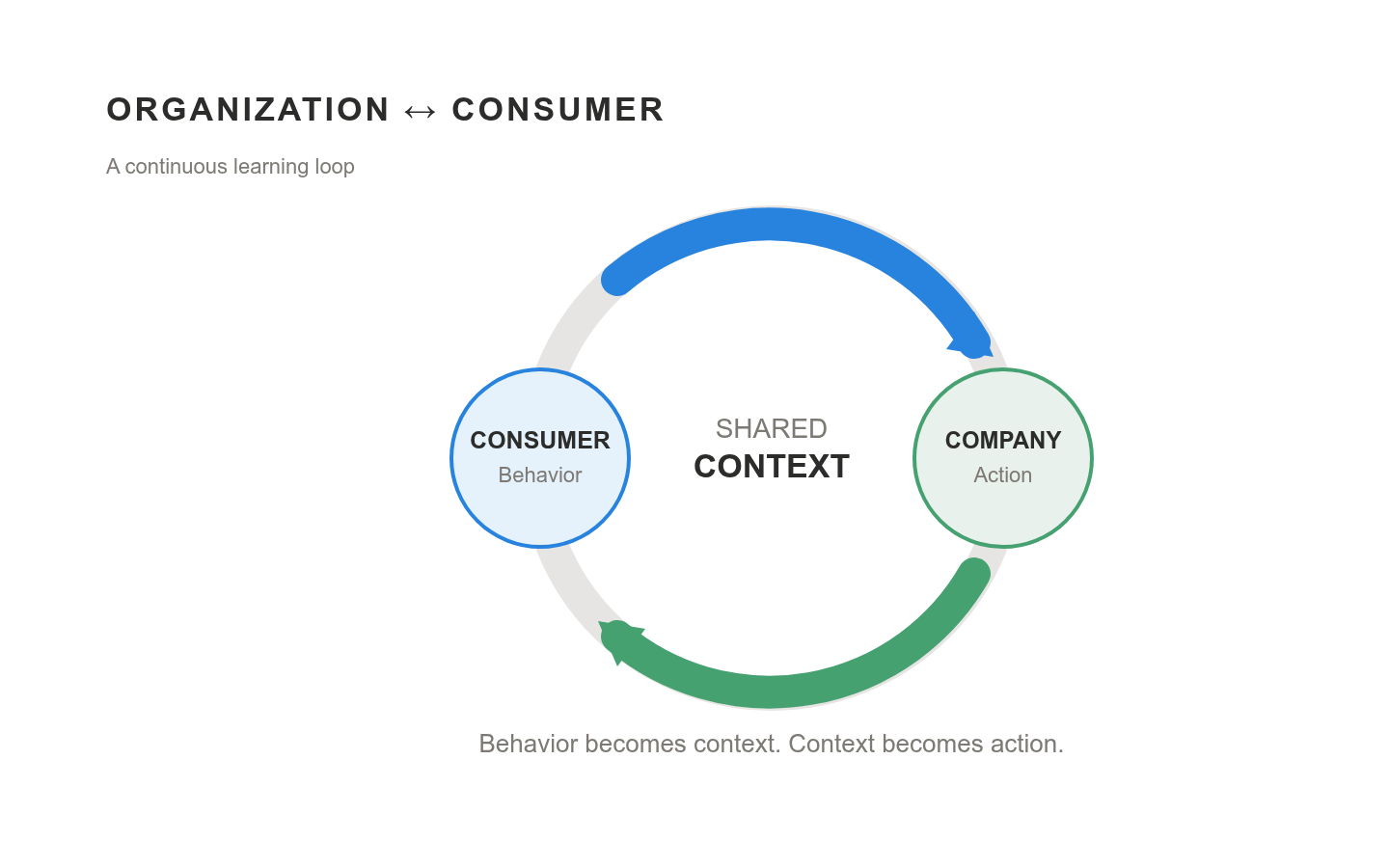
Organization ↔ Consumer: How does the organization understand and respond to the people it serves? How does consumer behavior flow back into the company and change what it does?
These are not three separate departments. They are three ways of looking at the same organization. Together, they may help us understand whether a company is merely adding AI to an existing structure or becoming something fundamentally different.
Lens One: Human ↔ Human
As I wrote last week in “The Org Chart Is Dying. What Comes Next?”, Zeng Ming’s vision for how future organizations operate, and how business strategy should be generated, resonated with how I think about the future of business.
The industrial era emphasized standardization and standard operating procedures. Strategy was manufactured near the top, while most people executed the plan. Because strategy did not change at today’s speed, companies could periodically lean on consulting firms to analyze the market and tell them what to do.
The information era brought an explosion of information. Deciding what to do, and perhaps more importantly what not to do, became more difficult. Organizations again leaned on consultants to make sense of the complexity.
But the AI era changes this arrangement. No matter how much consultants know, the context any company can share with an outsider will always be limited. At the speed of AI, strategy is constantly changing, adapting, and evolving.
Zeng Ming’s point is that the starting point for strategy is how an organization is composed and how it operates. In a sense, how the organization is organized largely determines whether its strategy will succeed.
This is the first relationship to examine: how humans relate to other humans inside the company. Who has access to information? Who makes decisions? How many people exist mainly to route context from the bottom up and decisions from the top down? Is the organization a pyramid, or is it becoming a network in which people can access the same business context more directly?
The future organization may not simply be flatter. It may be more rounded and interconnected. Instead of context living inside departments and management layers, people could plug into a shared internal world model: a continuously updated representation of operations, finance, product, engineering, and everything else the company knows about itself.
In that structure, strategy would no longer be something only top executives decide or something periodically outsourced to a consulting firm. It could become an evolving organizational capability. As more context is generated, the organization could continuously identify what should be prioritized, eliminated, tested, or accelerated.
Lens Two: Human ↔ AI
The second relationship is between humans and AI.
Most companies today are still human centered organizations using AI tools. Their structures were designed around human labor: people gather information, move it through management layers, make decisions, and coordinate execution. Adding a chatbot or an AI feature does not necessarily change that structure.
An AI native company may be different from the beginning. AI agents are not simply tools outside the organization. They become part of how the organization remembers, reasons, coordinates, and acts. Humans and agents contribute to the same operational reality.
This raises a harder question: where do humans fit?
I think humans increasingly serve at the edges, at the limits of AI capability. Where AI cannot reliably complete a workflow, humans step in. They resolve the exception, add judgment and context, and help the system learn. If the workflow can later be automated responsibly at equal or better quality, the human moves to a new frontier.
Human jobs may increasingly involve leading swarms of AI agents, exploring edge cases, establishing standards, and deciding what should or should not be automated. In the most extreme version, our work becomes helping AI replace more of our work as quickly and broadly as possible.
But human responsibility cannot disappear with human execution. People still need to determine purpose, exercise ethical judgment, build relationships, challenge what the model optimizes, and remain accountable for the consequences.
This lens is therefore not only about how much AI a company uses. It is about the role AI occupies inside the organization. Is AI assisting individual employees, or is it becoming part of the company’s operating intelligence? Are humans merely feeding the system, or do they retain the power to question, redirect, and govern it?
Lens Three: Organization ↔ Consumer
The third relationship is between the organization as a whole and the consumers it serves.
People can say anything, but what they do often reveals more than what they say. What people are willing to spend money on can be a particularly meaningful signal. Transactions are not the only source of truth. Product usage, customer support, communities, regulation, and culture also matter. But economic behavior can show the difference between stated preferences and demonstrated choices.
This is the external world model: a continuously changing representation of what is happening outside the company.
Imagine a furniture company. A customer searches for a sofa, checks its dimensions, buys it, and then returns it because it will not fit through the apartment doorway. The external model sees the search, purchase, delivery, and return. The internal model sees the product dimensions, inventory, delivery costs, return reason, and support conversation.
Together, the two models can identify a recurring problem and recommend a simple solution: let customers enter their doorway dimensions before buying, and warn them when an item may not fit. Product, engineering, operations, and finance can evaluate the change using the same context.
Customer behavior changes the internal model. The internal model changes the product. The changed product creates new customer behavior, which updates the model again.
For the internal world model, a stable, secure, reliable, and reasonably cost effective AI operating system may become essential. For the external model, blockchain could provide a ledger for transactions that is verifiable, programmable, and difficult for any single company to rewrite.
I am not arguing that every piece of consumer data should become public or permanent. The important questions are who owns the data, who can access it, how consent works, and whether people can participate without surrendering their privacy. Technologies such as zero knowledge proofs may allow a system to verify something about a transaction without revealing every underlying detail.
The case for blockchain, then, is not simply immutability. It is the possibility that consumers, companies, and AI agents could exchange value without placing the entire economic layer under the control of one platform.
Can We See the Future Organization From the Outside?
This framework sounds clear in theory. Applying it is much harder.
Many of these relationships are embedded deep inside how a company operates. A portfolio description, company introduction, or website may tell us what the company sells, but not how humans share context internally, how much authority its agents have, or how consumer behavior changes organizational decisions.
So how do we spot the current company that may become the AI native company?
Block is one example I keep returning to. It is already a large company, but parts of it appear to be transitioning toward this future. Goose and Buzz offer signals of the Human ↔ AI relationship: AI is moving closer to the operating layer rather than remaining only a customer facing feature. Cash App offers another signal in the Organization ↔ Consumer relationship: the company already sits close to consumer transactions and financial behavior.
That does not prove that Block is the company of the future. It gives us a test case. What does its internal structure tell us about Human ↔ Human? Are Goose and Buzz changing how the company itself works, or are they simply useful tools? Does Cash App create a feedback loop that changes the whole organization, or is it only one product in a portfolio?
The framework helps me ask the questions, but it may not yet help me answer them.
There may also be future companies whose products make the framework even harder to see. Imagine a kind of “brain as a service”: every company plugs in its institutional knowledge, and the system generates strategy, coordination, workflows, or decisions around it. Such a company may automate the intelligence layer for many organizations without looking like a future organization on the surface.
To identify these companies, we may need to examine more than what they sell. We may need to look at how they hire, how decisions move, what their internal tools can do, where agents are given authority, how capital is allocated, and how quickly consumer behavior becomes organizational action.
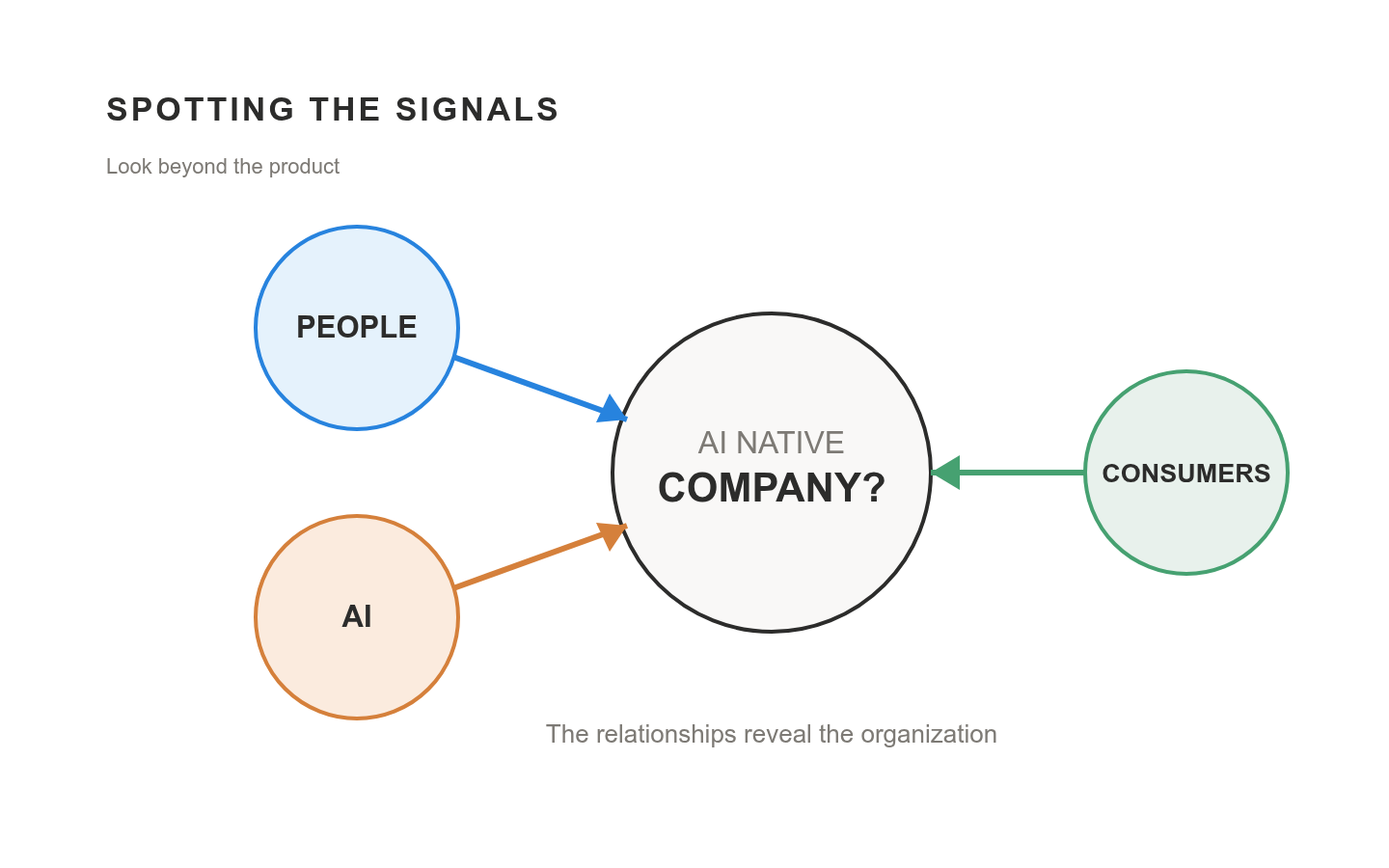
The future may be visible not in any single product, but in the relationships between them.
The Stakes Behind the Framework
There is an optimistic interpretation of this future. AI lowers the cost of starting a company. Small teams gain capabilities that were previously available only to large organizations. A new company designed around AI agents may move faster than an incumbent trying to bolt AI tools onto human centered structures and legacy workflows.
Open source models may reduce dependence on centralized providers. As capable models become cheaper to run locally, knowledge intensive organizations may adapt or operate their own systems. More workflows may move away from expensive general purpose token consumption toward smaller, specialized, and locally controlled models.
But the opposite force is equally powerful. Organizations with more capital, data, distribution, computing capacity, and intelligence can use those advantages to acquire even more capability. Their systems encounter harder problems, receive more feedback, and improve faster.
This is where the Matthew effect may accelerate. Those with more intelligence and more capacity to handle difficult problems will be given more difficult problems, and become even more capable. Those excluded from these systems may receive fewer opportunities to develop or demonstrate what they can do. The gap between rich and poor, powerful and powerless, could continue to widen. AI may make monopolies even more monopolistic.
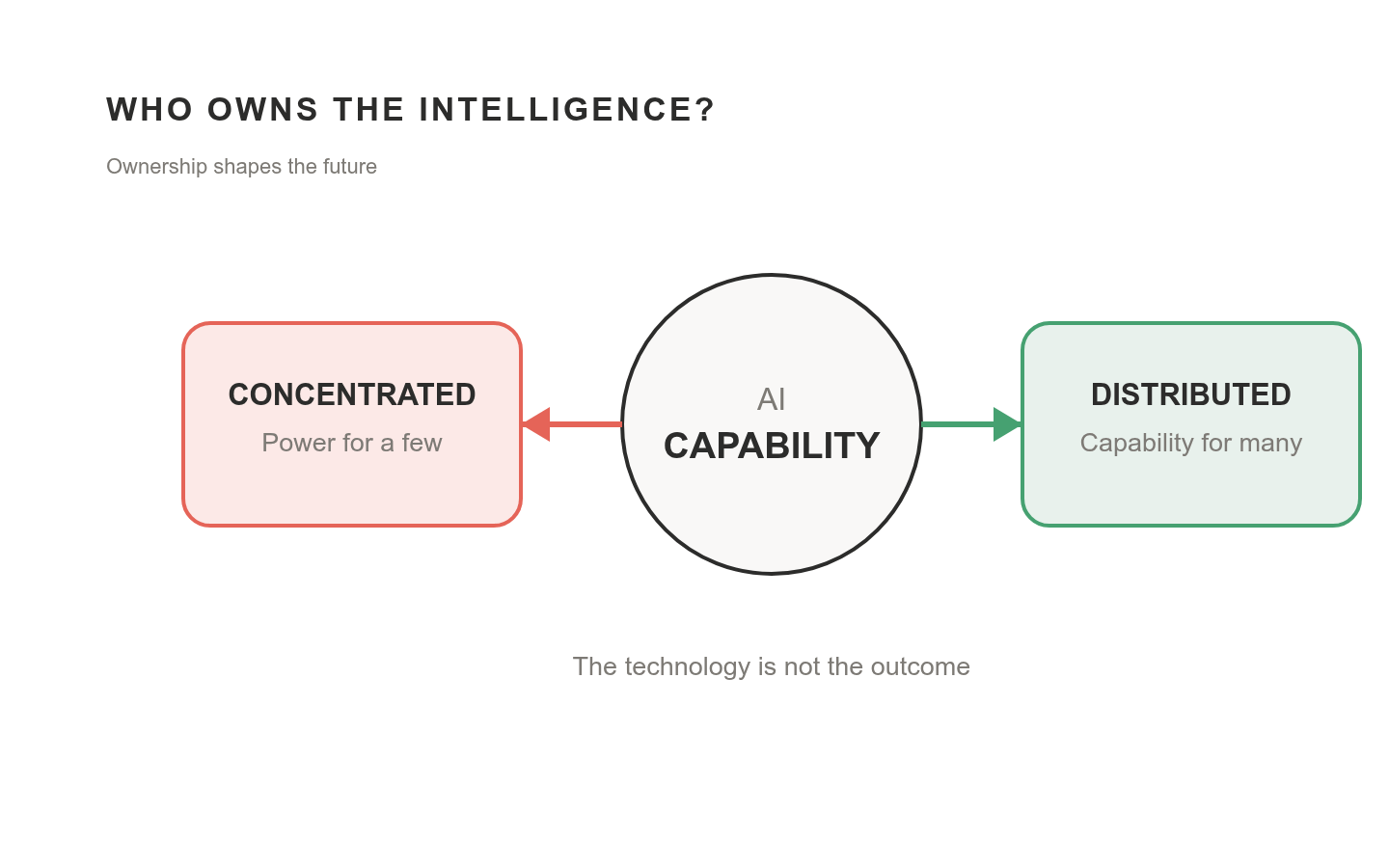
That outcome is not technologically inevitable. It will depend on ownership, education, access to models and computing, competition, governance, and whether people share in the value created by the systems they help train and improve. But it is a possibility we should confront directly.
The Question of Freedom
What do we do when AI becomes more capable than any individual person in many domains, and when it begins to direct our work, purchases, and decisions, or when we willingly hand over more of our thinking to it? What is left for humans, especially if the most capable AI is controlled by only a few institutions?
How do we protect freedom of thought, speech, association, and financial agency? How do we build decentralized AI systems where power is not concentrated, people retain control of their money and data, and intelligence supports human freedom rather than quietly narrowing it?
In the future, every company may become something like an intelligent being: sensing, learning, acting, and evolving. Some may be interchangeable. Others may become far more advanced. The most capable may absorb or eliminate those that cannot learn as quickly.
The three relationships help us see what is at stake:
How humans organize determines who has power.
How humans interact with AI determines who retains judgment and accountability.
How organizations interact with consumers determines who owns the feedback, the data, and the economic relationship.
The challenge is not only to build more intelligent organizations. It is to determine who owns that intelligence, what values guide it, who benefits from it, and whether human beings remain participants in the future rather than merely inputs to it.
The future organization may be built around AI. The future society must still be built around human dignity.
This is the first essay in my Back to the Future series. Next, I want to test this framework against practice by examining venture capital portfolios and looking for companies already building toward this vision. I want to see whether the three relationships can help us distinguish a company that uses AI from one that is becoming AI native, and where the future is already taking shape.
Till then, cheers!
Previous column articles can be found here: