

The most AI-native company of the future may not look much like a company at all. It may look more like one shared intelligence that is always learning, allocating resources, generating strategy, and pulling in humans where judgment matters most.
I listened to a ton of podcasts this week. Yesterday, I was so tired I could barely keep my eyes open, so I spent hours lying in bed listening. One conversation in particular caught my attention: Zeng Ming on the companies that may disappear in the AI era.
It is the closest thing I have heard to From Hierarchy to Intelligence, the essay by Jack Dorsey and Roelof Botha that has stayed with me since I read it a couple of months ago.
I have been thinking constantly about what it means to build an AI-native company. If building becomes much easier, the harder question is what to build and where to spend our time and resources, including our tokens. Right now, companies of every size are training staff on AI tools and adding AI to existing workflows. But is that actually the right approach?
Zeng argues that the hierarchical corporation is an industrial-age institution. If AI changes the economic logic that created the modern corporation, the organizational form may change with it.
He describes today’s “neo labs” as early experiments in what could come next, shaped by the example of OpenAI and Anthropic. Work becomes task-based instead of job-based. There are fewer layers, contribution is more visible, and more people operate like partners. The company starts to resemble a team that keeps winning rather than a classic firm.
Strategy changes too. Instead of being planned by a small group at the top and pushed downward, it becomes something the organization generates. Insight has to emerge from shared context, not tighter control.
This is what fascinated me, because Dorsey and Botha describe a surprisingly similar idea from another angle.
Their model has two parts. A Company World Model absorbs machine-readable traces of work, such as code, decisions, plans, discussions, problems, and progress. Instead of managers carrying status up and down the organization, the model maintains a living picture of what the company is doing and where its resources should go.
A Customer World Model uses real transaction data from Square and Cash App to understand customers’ financial reality. The company does not have to rely only on surveys, roadmaps, or a product manager’s assumptions. The system can learn from what customers actually do.
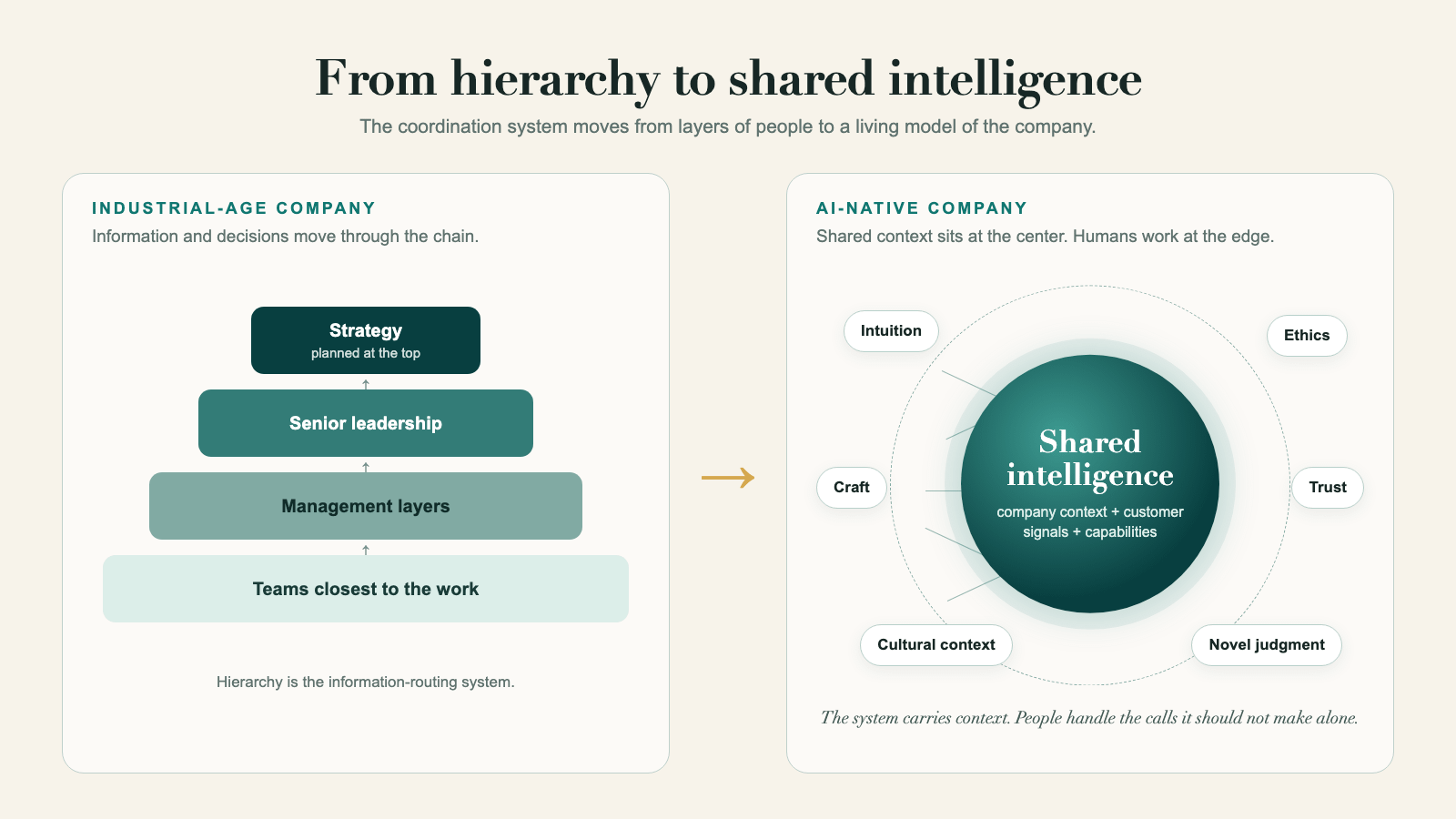
The hierarchy carries information through layers. The AI-native company puts shared intelligence at the center and moves people to the edge.
In both visions, hierarchy begins to collapse into one shared intelligence. The system learns about the organization and its customers, then uses that live context to surface strategy, allocate resources, and compose new solutions. Ideally, it notices what is needed before someone writes it into a quarterly plan.
Humans do not disappear, but their position changes. Dorsey and Botha place people “at the edge,” where the system meets reality. That is where intuition, ethics, cultural context, trust, taste, and craft still matter. Zeng describes roles that are less fixed, less layered, and more fluid. We become the bridge for the things agents still cannot do, or should not do alone.
This is why simply adding AI to an old workflow may not be enough. Zeng’s argument is that becoming AI-native requires an inside-out transformation. In some cases, it may be easier to build from scratch than to keep adding intelligence to an old skeleton.
The question is no longer only how to add AI to a company. It is whether the company itself becomes the AI. And if it does, where do humans go?
I find that possibility fascinating and a little unsettling.
I have been watching for companies that offer clues about what the next AI-native organization might look like. This essay is the beginning of a Sunday series about those experiments, especially the ones that feel like they could bring us back to the future.
I will share one every Sunday. Not because I think I know where all of this ends, but because the shape of the company is changing in front of us. I want to keep watching.
References
Till next time, cheers.