

Last week, we explored the idea that "anyone can make money, not just governments." Now, with the development of blockchain technology, everyone indeed can create money.
“1 million new tokens are created weekly”—Brian Armstrong, CEO of Coinbase
With millions of types of money available, how do we determine which ones are good? Which should we use? What makes money "good" anyway?
According to the International Monetary Fund:
"Money is anything that is widely accepted as a means of payment for goods and services or for settling debts, essentially acting as a medium of exchange, a unit of account, and a store of value, and can also be considered a standard of deferred payment."
In short, money must serve as:
Medium of exchange
Unit of account
Store of value
Standard of deferred payment
What do these qualities mean in practice, and what makes money "good"?
First- Usability.
As a medium of exchange, money must be convenient to use. Nobody wants to deal with currency that's cumbersome or difficult to transport.
"For a currency to be successful, it must be convenient and easy to use" —Hayek
Second- Stability.
To function as a unit of account, store of value, and standard of deferred payment, money needs stability. Eight hours of work should buy the same quality and quantity of goods today as it did yesterday and will tomorrow. The purchasing power should remain consistent.
In essence, good money must be both usable and stable. Yet these qualities alone aren't enough. For money to gain widespread acceptance as a means of payment,
it must also inspire trust.
“Good money should be stable, usable, and inspire trust”. —Hayek
Trust forms the foundation of any currency—without it, a currency cannot truly function as money. Trust in a currency's stability is essential for people to feel comfortable using it as money. Just as people trust banks to exchange their deposits for cash, they must trust currency issuers to maintain stability.
So, among bitcoin, ether, altcoins and the millions of meme coins, which ones qualify as "good money"?
Let's examine the current "mainstream" coins in the market.
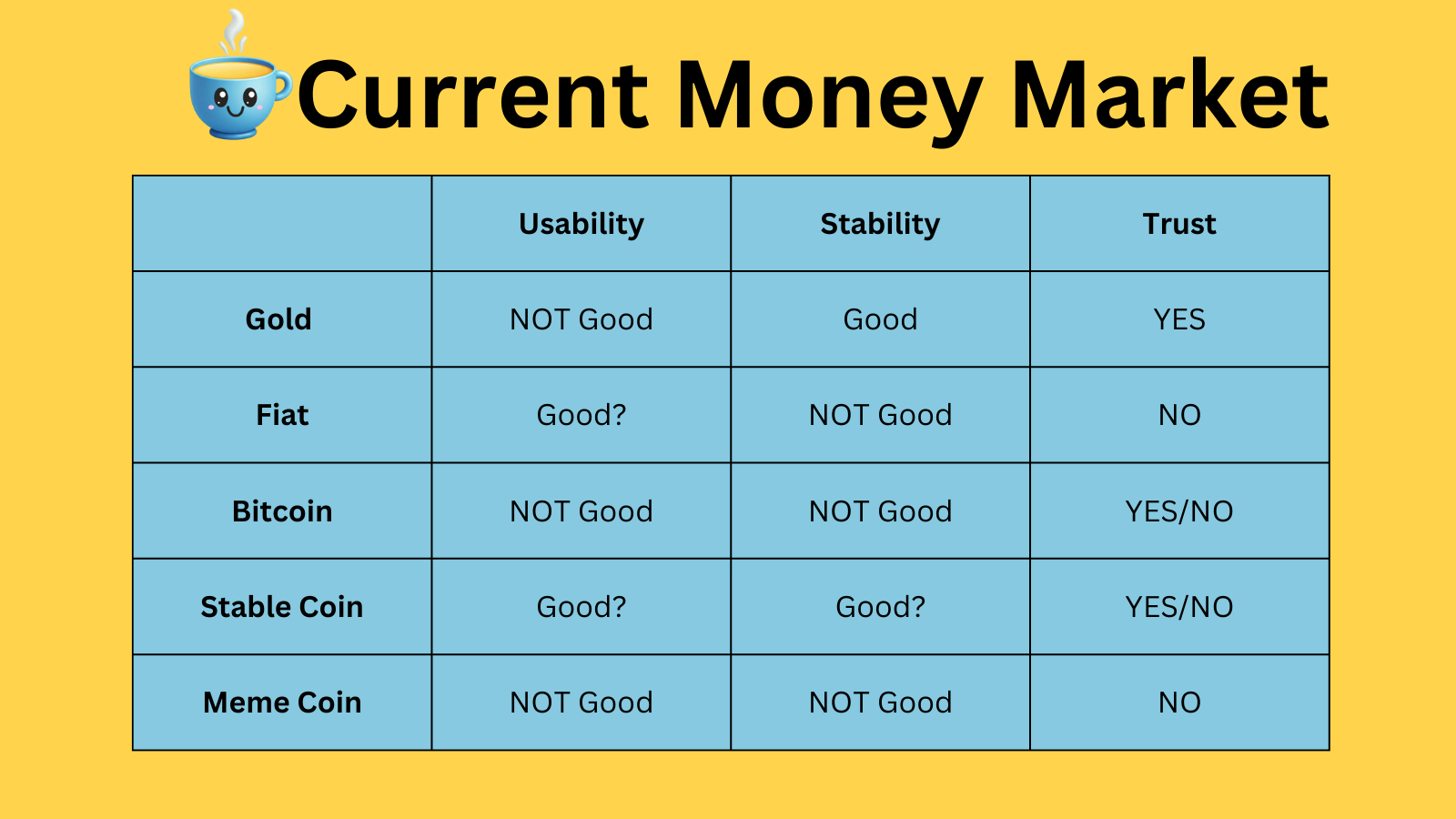
It seems we haven't yet reached the ultimate definition of "good money." (More on the current money market later this week!) The question becomes:
How do we create money—or the infrastructure for money—so that it's good?
Let’s revisit the definition of Money one more time.
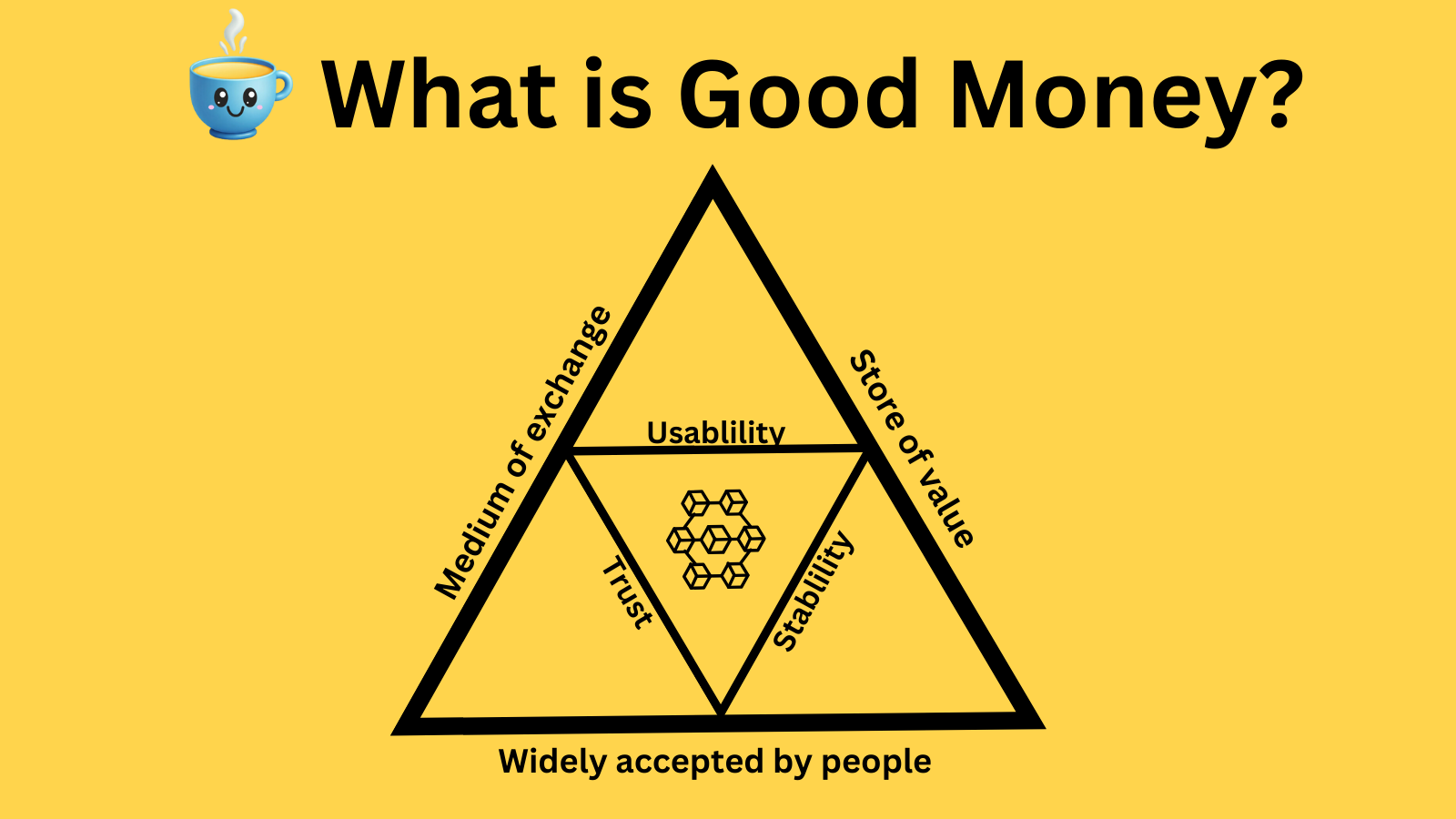
Usability:
This challenge is largely addressed by blockchain technology.
Blockchain makes money more usable than ever before through immutable, transparent, decentralized ledger technology.
It offers various transaction methods like hot and cold wallets.
Transaction costs can be reduced significantly as technology improves, particularly through increased TPS (transactions per second).
Stability:
Hayek suggests "currencies should be kept stable in terms of a collection of raw material prices."
For example, gold has served as a medium of exchange for centuries, not necessarily because of its intrinsic value, but because of its scarcity in the market.
While being tied to a raw material like gold helps maintain stability, the key factor is the transparency of money supply and circulation. People need to know the total amount of money in existence and in circulation AT ALL TIMES—something blockchain technology can effectively track.
Trust:
Blockchain's decentralization, transparency, and immutability allow laws to be encoded directly into the system, where no one stands above the technology and every transaction can be traced.
Innovations like governance tokens enable individuals to vote on protocols and policies, helping realize true DAOs (Decentralized Autonomous Organizations).
While the technology for building trust already exists today, regulatory frameworks and government controls remain obstacles.
To build complete trust, governments must return money-creation rights to the people—a step toward true freedom and democracy. They should stop forcing fiat currency usage, end protectionist policies, and allow government-issued money to compete fairly in the free market.
Ultimately, the government's monopoly on money creation should end. Money should be treated like other products and commodities—produced, traded, and regulated by free markets alone.
In short, people should be able to choose their preferred currency:
People are free to reject money they do NOT trust
People are free to choose money they trust
Now that we've explored what makes money "good," our next article will take a deep dive into the current money market with "The State of Crypto Today: Barriers, and Breakthroughs".
I'll try to use plenty of visuals and straightforward language to explain my understanding of these concepts—challenging topics to simplify, but I'm up for it! :D
Until then, cheers!🍵