

TL;DR:
Elon Musk’s companies are not separate bets. They are one connected plan. XAI is the brain, Tesla is the body, X is the voice and data layer, Neuralink is the human interface, The Boring Company builds the underground infrastructure, and SpaceX is the transport that takes all of it beyond Earth. AI will eventually be free for everyone. When that happens, the real question is not what AI can do. It is what you will do with it.
Everyone is talking about the SpaceX IPO. But the IPO itself is not the story. The story is what it signals.
After watching Lewis Hong’s SpaceX VC interview, something clicked for me. SpaceX is not a rocket company anymore. It is infrastructure, the way the internet was never really just email. Rockets happen to be the vehicle, but what Musk is actually building is the ability to move mass, energy, and intelligence beyond Earth at a cost that was previously unthinkable. Reusability is the unlock. Once you can reuse a rocket the way you reuse a plane, the economics of everything in space changes.
Lewis made a point that I keep thinking about. Scientists were spending enormous effort building labs that simulate space conditions, trying to manufacture things that zero gravity makes easy. At some point, the obvious question becomes: why simulate it when you can just go?
That question is bigger than it sounds. It is the same logic behind everything Musk is building.
The Ecosystem: Brain, Body, Voice, Interface, Infrastructure
Here is what I did not fully appreciate until now. These companies are not separate bets. They are one system.
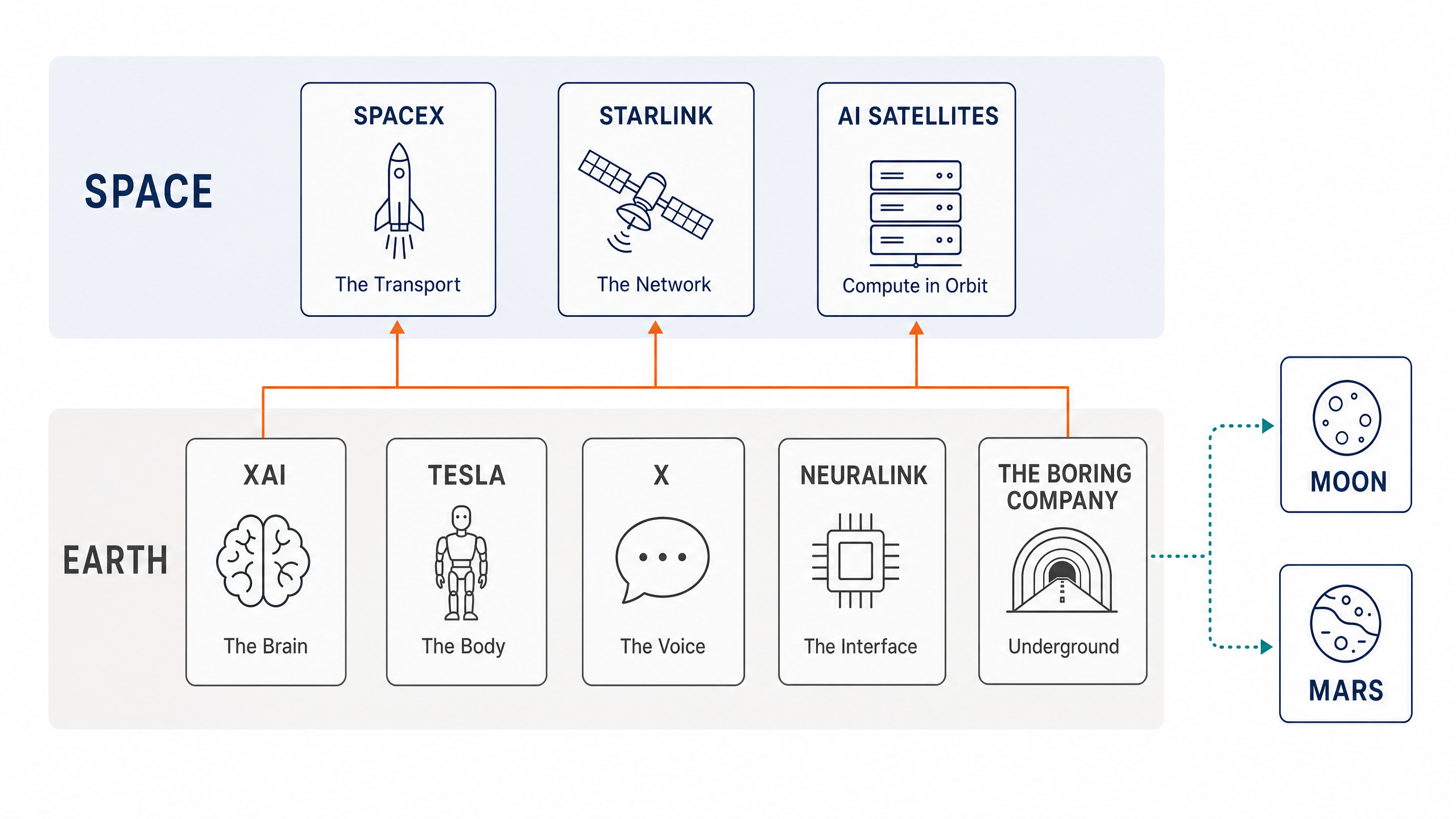
XAI is the brain, the intelligence layer. Tesla is the body, physical AI made real. Full Self-Driving is essentially a robot navigating the world, and the Optimus humanoid is just the next step in that direction. X, formerly Twitter, is the voice and the data layer. Hundreds of millions of people post on X every day, which makes it the world’s largest real-time feed of human thought. That data trains xAI. The brain needs a constant stream of information to learn from, and X provides it.
Neuralink is the interface. With human consent, a chip in the brain connects a person directly to this network of intelligence. It is not science fiction anymore. It is the bridge between human cognition and machine capability, a way for people to stay not just relevant but genuinely enhanced in a world where AI handles most of the cognitive and physical work.
And then there is The Boring Company. On the surface, it builds tunnels. But think further ahead. If humans are going to live on Mars or the Moon, the surface is not where we will be. Radiation, temperature swings, no atmosphere. We will live underground. The Boring Company’s entire capability points directly at that problem. Lewis Hong raised this connection, and I think it holds up.
All of it, XAI, Tesla, X, Neuralink, The Boring Company, SpaceX, points toward one destination: make humanity multi-planetary and bring science fiction to life.
The Space Economy: What Gets Built When the Cost Collapses
A new economy is forming around space, and most people have not noticed yet.
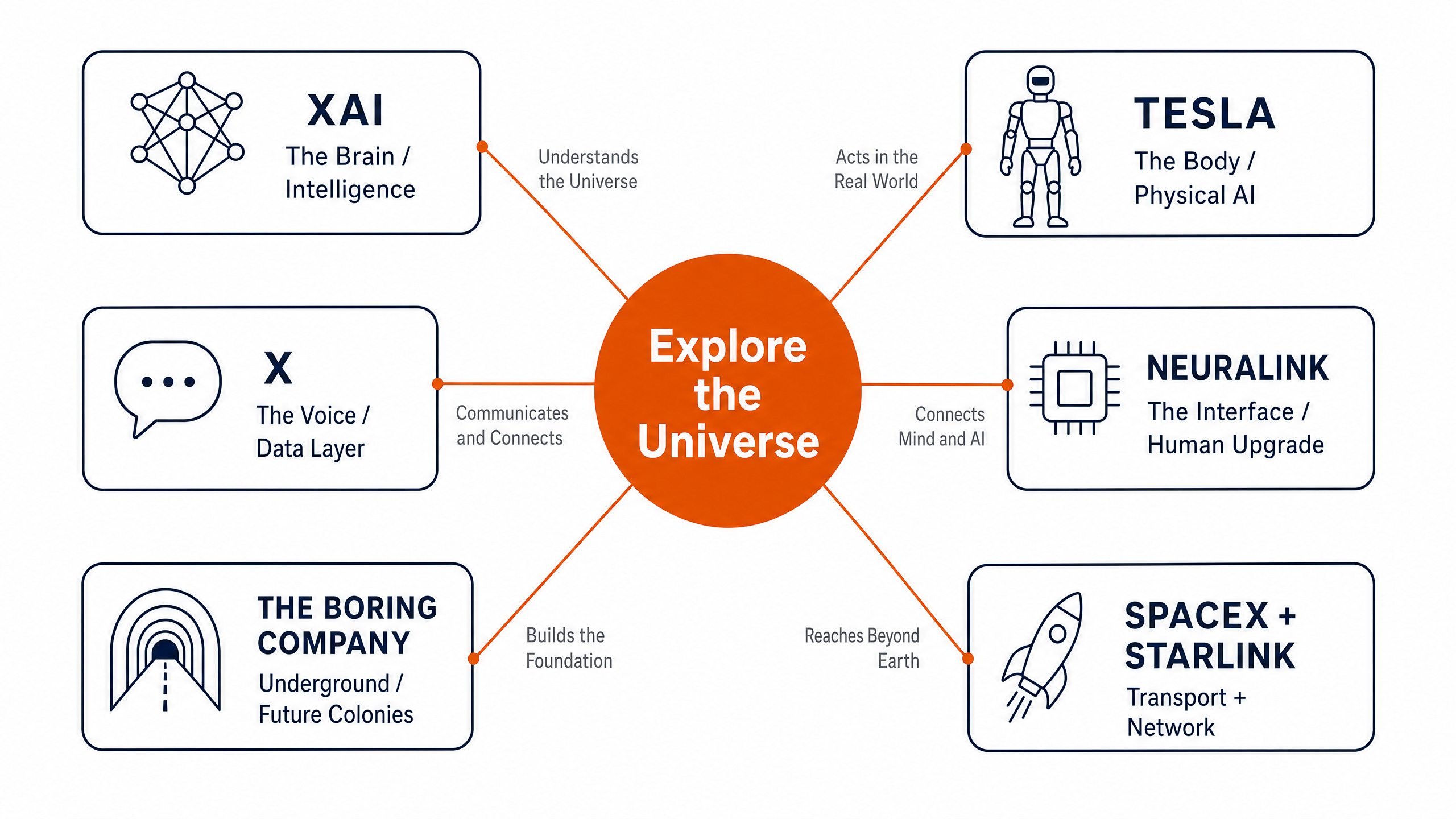
We are talking about data centers in orbit, powered by unlimited solar energy and cooled by the vacuum of space, connected to Earth through Starlink’s laser links. We are talking about zero-gravity manufacturing for materials that simply cannot be produced on Earth. We are talking about colonies on the Moon and Mars, not as distant fantasy but as the next logical step in a plan that is already being executed.
When Musk did not have enough chips, he built his own. Terafab is doing that now at a scale that dwarfs anything previously attempted. When he did not have enough compute, he built that too. Anthropic and Google have already signed deals with SpaceX to access that compute. And Musk is not overselling it. He is offering 90-day commitments, no more, because he knows the pace of change makes longer promises unreliable.
Eventually, robots will do the heavy work on Mars. Humans will direct, explore, and build. That is not a distant dream. It is the logical endpoint of what Tesla’s Optimus program is already working toward.
Eric Jorgensen, who wrote the definitive book on Elon Musk, noted something worth sitting with:
the world’s first trillionaire is not a banker, not a fund manager, not a politician. He is an engineer who builds things that did not exist before.
That matters. It is a signal about what the world is beginning to value, and what kind of work actually moves civilization forward.
When Musk spoke at the Nasdaq IPO, the excitement was not performed. He said it himself: what keeps you going is waking up every morning unable to wait to see what happens next. That kind of genuine drive is rare, and it shows in the results.
AI Is the Tool. The Universe Is the End.
Here is the part that people miss when they talk about AI.
Intelligence is becoming a commodity. The leading models are converging. Open source is catching up fast, and the gap between the best closed model and the best free model is shrinking every few months. At some point, and it may not be far off, capable AI will be available to anyone at essentially zero cost.
That does not weaken the Musk ecosystem. It actually makes it more valuable. When intelligence is free, the scarce thing becomes what intelligence enables: physical infrastructure, energy systems, transportation, manufacturing, space. You cannot download a rocket. You cannot fork a Mars colony on GitHub. The companies in this ecosystem are not selling intelligence. They are building the world that intelligence makes possible.
So the question shifts. Not what can AI do, but what will you do when AI can do almost anything?
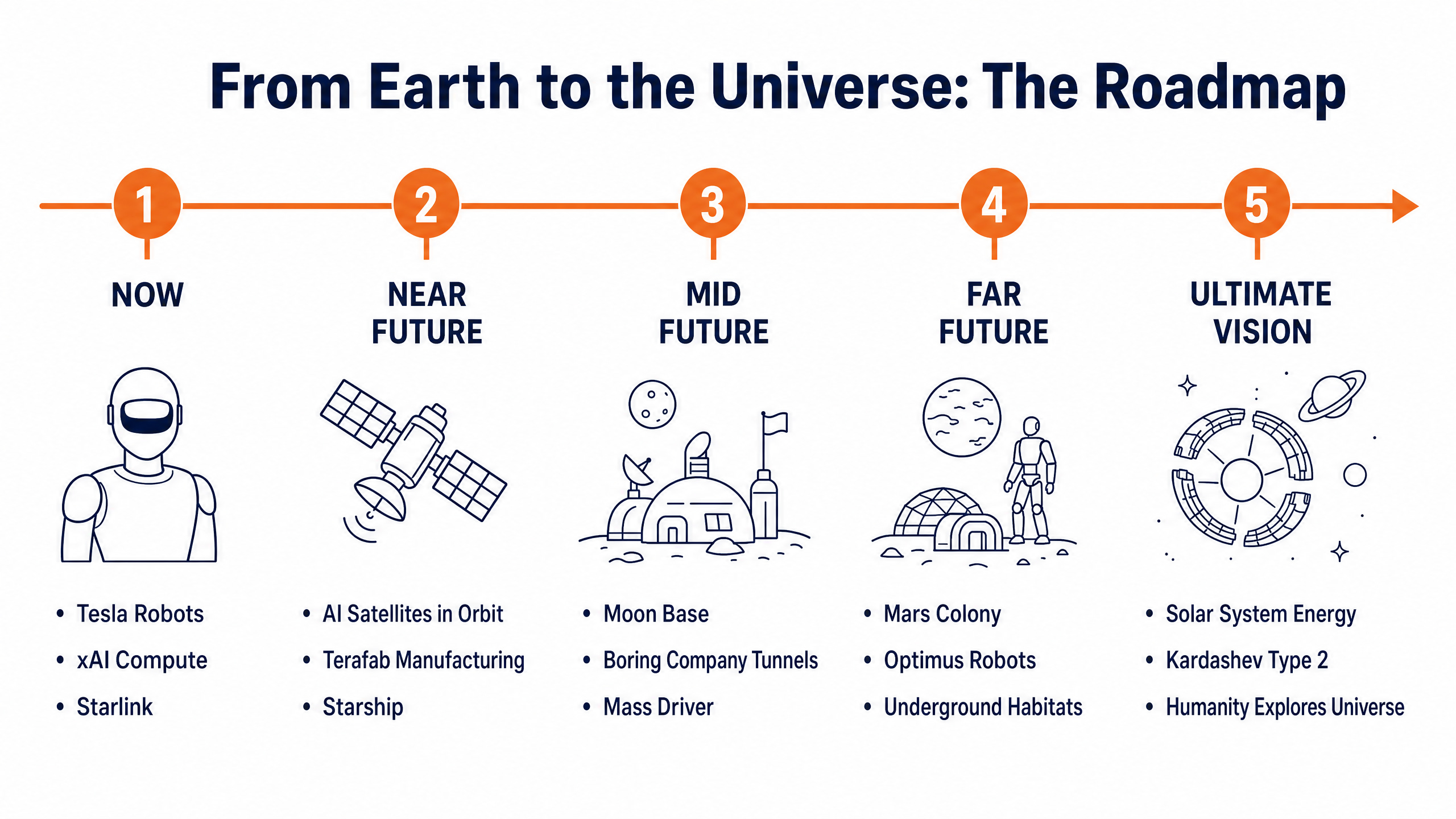
AI is the tool, not the destination. The destination is something much older and much harder to define: understanding what humanity is, finding out what the universe is made of, and asking questions that no one has thought to ask yet. Musk has said it in different ways across many speeches. The universe is the answer. You just have to figure out the right questions.
When AI can answer almost everything, what will you ask?
That is the question worth thinking about.
Till next time, Cheers!
Previous column articles can be found here:
https://newsletter.ownlyagent.com/t/teacolumn
Recommended watching: