

The other morning, I woke up to a problem that nobody warns you about when they talk about AI productivity.
Overnight, my AI agents had been running in parallel. By the time I opened my laptop, eight different projects were waiting for me. They had all reached a point where they needed a strategic decision to move forward.
I looked at the first one, loaded the context into my brain, and made the call. I did the same for the second. By the third, I was completely exhausted. I simply did not have the capacity to review the rest of the work and give them the right instructions. And these were important decisions—if I didn’t read through them carefully and give clear direction, the agents would just waste compute doing something completely wrong.
The bottleneck wasn’t the AI. The bottleneck was me. More specifically, it was my capacity for deep, high-quality judgment.
This experience got me thinking about context management, and how the way AI systems work is actually a perfect mirror for how human beings operate.
The Mirror
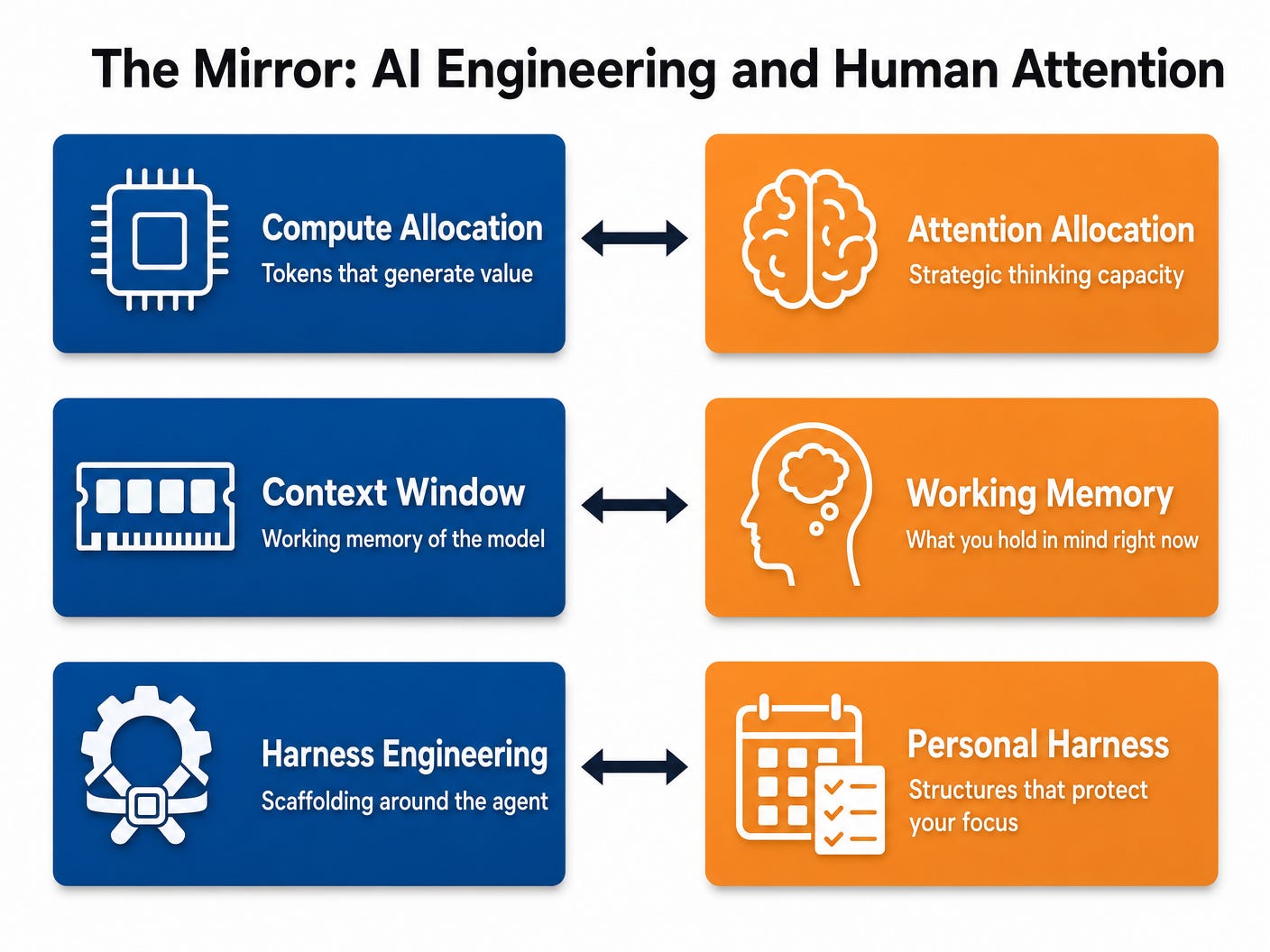
Right now, AI engineering is obsessed with compute allocation. Compute means tokens, and tokens are what generate value. Even companies that promote “token maximization” do it because they want their engineers to find ways to create value. But compute is finite. How do you allocate it? What is your North Star? It comes down to priorities. As Elon Musk has pointed out, if you just focus on removing the one main blocker every week, everything else starts to resolve itself.
For humans, compute is attention. There is a famous AI paper called “Attention Is All You Need”, and for human beings, that is literally true. Attention is all we have. It takes immense energy and thinking capacity to focus on the things that matter. When you constantly have to make strategic decisions, you run into decision fatigue. Your capacity to think strategically is limited.
Once priorities are set, the next challenge is executing the task. In AI, this is called context engineering—managing what goes into the context window. The context window is just like our working memory. If you load all the learnings, all the patterns, and the entire big picture into the window at the beginning, there is no space left to actually process the specific task at hand.
It is the same for us. If you have five projects loaded in your working memory, along with the financial worries and the grand vision, you will freeze. There is a Chinese saying: your eyes are looking too high up, and you are not able to go low enough to pick up the low-hanging fruit. If you only look at the goal, you will never take the steps toward it.
This brings us to the third concept: harness engineering. A harness is the scaffolding you put around an AI agent to help it work better—knowing what to remember, what to forget, and how to self-repair.
But what is the harness for us? How do we manage our own capacity when we have multiple projects running simultaneously?
Building Your Own Harness
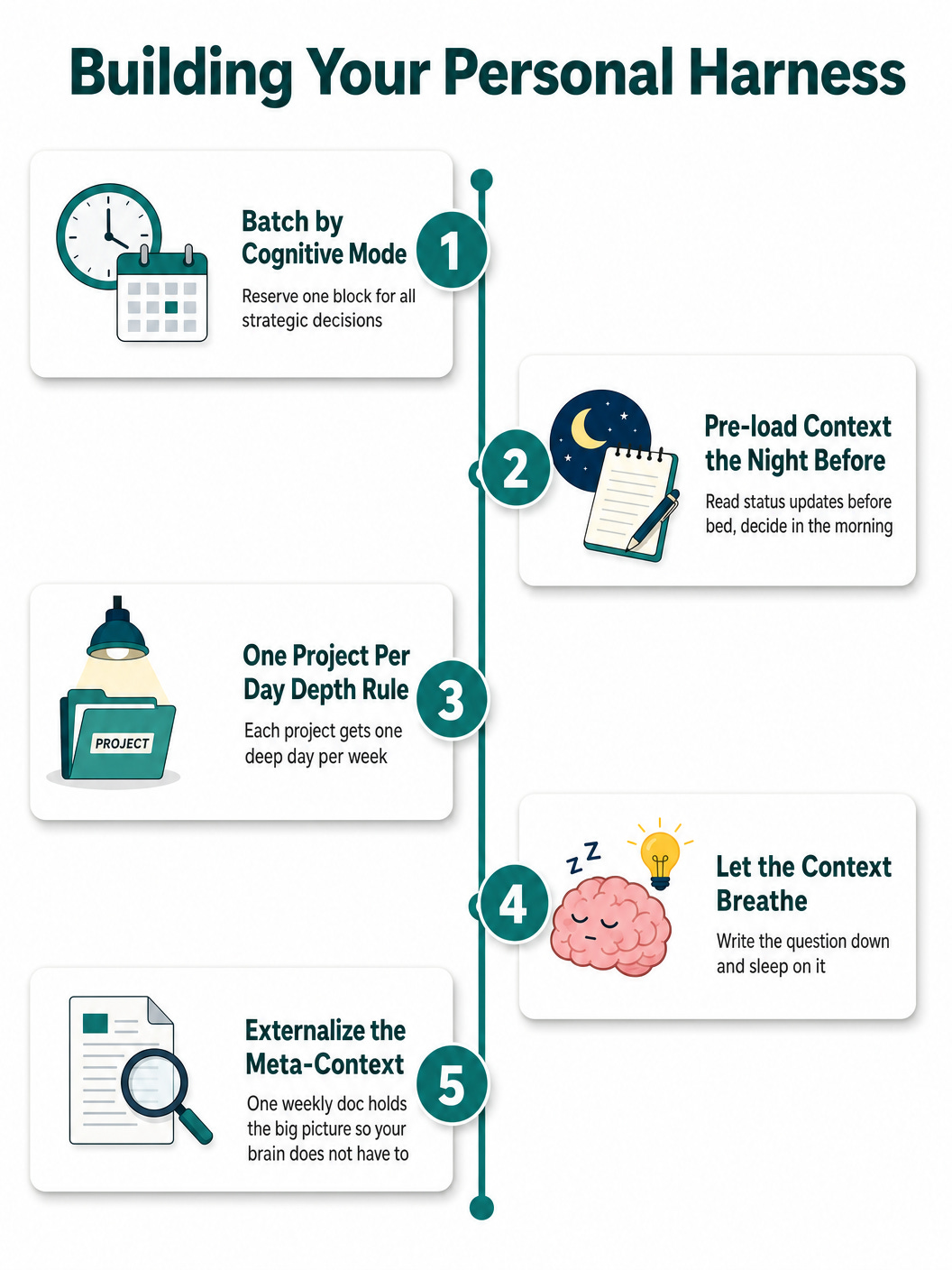
I am still figuring this out, but here is what I am learning about managing my own attention so I can actually generate value instead of just burning out:
1. Batching by cognitive mode, not by project. Strategic decisions require slow, deliberate, high-context thinking. Instead of context-switching between projects throughout the day, I am realizing the value of designating one block of time—maybe the first 90 minutes of the day—as a decision window. Outside of that window, I am in execution mode.
2. Pre-loading context the night before. Reviewing eight projects in the morning is exhausting because you are doing two things at once: loading the context and making the decision. If you spend 15 minutes the evening before just reading the status updates without making any decisions, your working memory is primed for the next morning. The decision becomes much cheaper.
3. The “one project per day” depth rule. For each project, designate one day a week where it gets your deepest attention. The other days, it only gets reactive responses. You cannot go deep on five things in one morning, but you can spread that depth across the week.
4. Letting the context breathe. Sometimes, when you hit decision fatigue, the best thing to do is write down the one question you need to answer, and sleep on it. Your brain consolidates information when you rest. The answer often surfaces faster the next day.
5. Externalizing the meta-context. In a multi-agent system, an orchestrator holds the big picture so individual agents don’t have to. You can do this for yourself: keep a single document updated weekly with your priorities and the status of each project. Write it down so your brain doesn’t have to hold it all in working memory.
The Ultimate “Why”
These frameworks are borrowed directly from AI architecture. We are applying AI engineering back to ourselves. But all of this attention management leads to a much bigger question.
AI is the means, not the ends. We cannot mix up means with ends.
If AI is freeing us from busy work, repetitive tasks, and execution, what exactly are we freeing our attention for?
In the past, great thinkers had the leisure to ponder the meaning of life because their basic needs were taken care of. AI has the potential to do that for us at scale. If we don’t have to do the busy work, we have the time and energy to create, and to ask the ultimate questions. What is the meaning of life? Why do we live?
For me, the ultimate answer is God. As Viktor Frankl noted in Man’s Search for Meaning, the search for meaning is often the answer itself. I want to use the time AI gives me to understand God better, and to bring love to others.
As Nietzsche said, “He who has a why to live for can bear almost any how.” AI is increasingly figuring out the how. That makes our why the most important thing we possess.
The Warning
But there is a flip side to this freedom.
What will people actually do with their free time? History shows that rulers often keep people busy so they never ask the big questions. If we are not careful, AI could become a new kind of control.
If we outsource all our thinking, our memory, and our work to AI—and if that AI is controlled by a few massive corporations—we become digital colonies. We become slaves without even realizing it.
When you outsource your judgment to AI, you stop training your own thinking muscles. If you don’t criticize the work, you lose the ability to differentiate good from bad. You lose your taste. And once you lose your taste, you lose your agency.
Attention is your most valuable resource. Jordan Peterson once noted that attention is basically worship—whatever you pay the most attention to becomes your god.
In an era where knowledge is democratized and execution is cheap, your attention and your judgment are all you have left. Build a harness to protect them. Figure out your why. Because if you don’t decide what to pay attention to, someone else will decide for you.
Till next time, Cheers!
Previous column articles can be found here: