

Hello, dear TEA-mates! Here is what you need to know today.
1. 🔄 NEAR Rallies 15% In A Day As Cross-Chain Intents Cross $19B
NEAR token climbed 15% in 24 hours to $2.8, extending a month-long run of roughly 90% gains. The rally is driven by NEAR Intents, a cross-chain transaction layer that has processed over $19 billion in cumulative volume and generated about $32 million in fees by letting users request outcomes (like swapping USDC on Ethereum for SOL on Solana) while third-party solvers handle execution. BitMEX co-founder Arthur Hayes called NEAR, Hyperliquid’s HYPE, and ZEC crypto’s “holy trinity.” Institutional flow is showing up too: the Bitwise NEAR Staking ETP in Europe now holds about $40 million in assets, with $7 million in inflows in a single week. A June network upgrade will introduce dynamic resharding to auto-split shards under load. NEAR still trades far below its 2022 peak near $20. (Read More)
🫖 TEA For Thought: “Let’s not forget that NEAR started off as an AI company and then switched to blockchain.”
2. 🤖 Human Archive Raises $8.2M To Pay Indian Workers $1/Hr To Train Robots
Human Archive, founded by UC Berkeley students Samay Maini, Rushil Agarwal, and Shloke Patel along with Stanford’s Raj Patel (CEO), raised $8.2 million from Wing Venture Capital, NVP Capital, Y Combinator, and angels at OpenAI, Nvidia, Google, and Meta. The startup pays Indian gig workers roughly $1 per hour to wear camera-equipped caps, tactile gloves, motion capture suits, and wrist cameras while doing everyday service work. It has deployed over 1,000 active headsets across India’s home services, hotel, and restaurant sectors after being rejected by Urban Company and Pronto. Wing VC says the rig captures synchronized RGB-D video, force feedback, and full-body motion at scale. Consumers get discounted services in return for consenting to recording, with faces blurred under India’s Digital Personal Data Protection Act. Expansion into Southeast Asia and the U.S. is underway. (Read More)
🫖 TEA For Thought: “The era of downloading the internet is over. The era of uploading humans is here.”
3. 🛡️ Cybersecurity Hiring Up 11% As Anthropic And OpenAI Ship Offensive Models
Cybersecurity job postings in Q1 rose 11% year-over-year per Glassdoor, while executive search firm Heidrick & Struggles reports a “five-, maybe sevenfold” jump in demand since last fall. Roles that used to appear once a year are now requested weekly by Fortune 100 companies, and search firms are turning clients away. Anthropic recently released its Mythos model, which can identify and exploit vulnerabilities in critical infrastructure like power grids and financial systems. OpenAI followed with GPT-5.4-Cyber. LinkedIn CISO Lea Kissner put it plainly: “We’re going to need people to deal with the bug-pocalypse.” Security engineer Brian Gaudenti is among those adapting by learning AI tooling, since defenders increasingly use the same models to generate code (and sometimes the same vulnerabilities), which paradoxically drives further hiring. (Read More)
🫖 TEA For Thought: “AI is way better at offense than defense. For now, humans paired with a super AI might be able to defend. But soon it will have to be AI against AI. Swarms of AI against swarms of AI.”
4. 🐢 Engineer Argues AI Lets You Ship Better Code, Slower
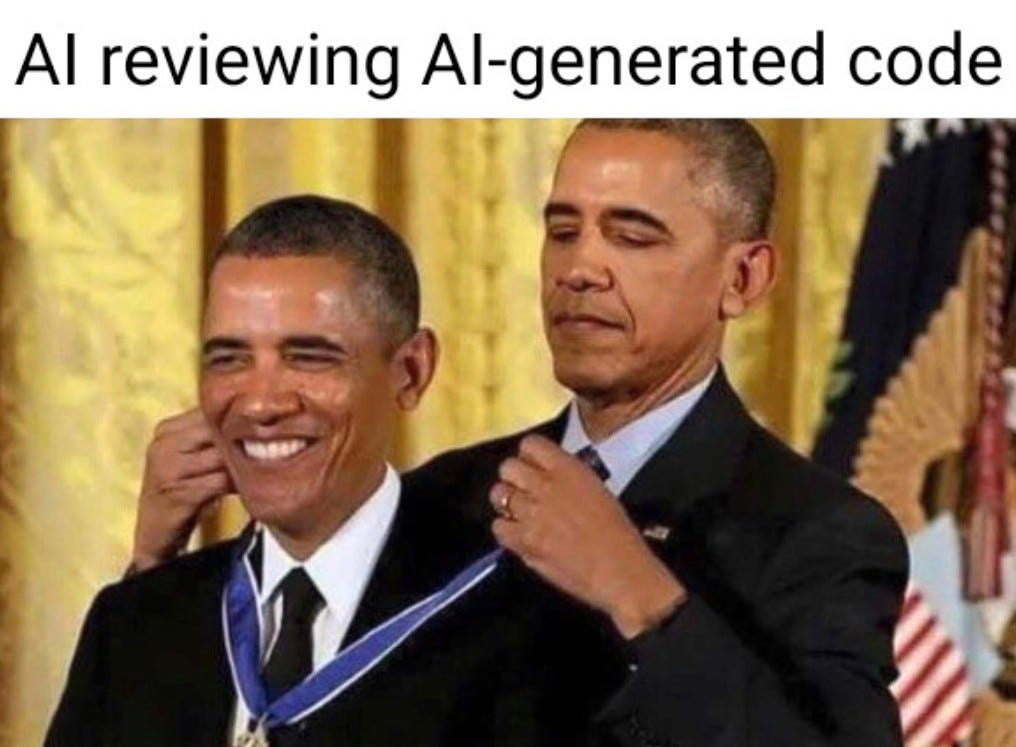
Nolan Lawson argues the prevailing “AI = fast, sloppy code” narrative misses a quieter use case: using LLMs to ship higher-quality code at a more measured pace. His workflow runs Claude (Opus 4.7 on extended thinking), GPT 5.5 Codex, and Cursor Bugbot in parallel as code reviewers, then consolidates their findings across critical, high, medium, and low severity tiers to filter false positives via cross-model validation. Fixes start with critical and high issues, skip low-ROI items, and abandon fundamentally flawed approaches. Lawson documents heavily with Markdown and Mermaid diagrams so future readers can follow the PR. He warns the method “finds so many bugs that you’ll be bored senseless if you try to tackle them all,” because it surfaces pre-existing code rot, turning feature work into deeper architectural side-quests that compound long-term codebase understanding. (Read More)
🫖 TEA For Thought: “Make better better by aiming at better.”
5. 🌐 Wix Cuts 1,000 Jobs As AI Threatens The Website-Builder Business Model
Wix is cutting roughly 1,000 jobs, about 20% of its 5,277-person workforce (over 60% Israel-based at the Glilot Junction campus), as investors worry website builders become irrelevant when anyone can prompt a site in five minutes. The stock has dropped nearly 50% since early 2026, dragging the valuation to about $2 billion. Q1 2026 posted a $57.5 million net loss on $541 million revenue (up 14%), with cash flow down 21% to $112 million and operating expenses up 50% to $423 million (now 35% of revenue, up from 21%). CEO Avishai Abrahami is pivoting via the Base44 acquisition (natural-language AI programming, $150 million ARR by May 2026) while Wix simultaneously builds its own AI model, a move that is pushing compute costs higher even as it tries to define a post-prompt-first business. (Read More)
🫖 TEA For Thought: “This is tough. Business models like this are doomed in the AI era when any website can be generated with one prompt in 5 minutes. The real question is what could Wix have pivoted to before this happened? I’d pivot toward agentifying the websites: make websites agent-facing and agent-friendly. AEO is still a huge market, and current websites are not ready for agents yet.”
🛠️ Skill of the Day
Pre-Mortem Planner: stress-test any plan or decision by imagining it has already failed, then work backwards to find what killed it.
You are my pre-mortem strategist. I am about to commit to the plan or decision below. Before I commit, I want you to imagine it is now six months in the future and this plan has clearly failed. Your job is to figure out why, in concrete terms, and help me fix it before I start.

Plan or decision: [PASTE YOUR PLAN, DECISION, OR PROJECT BRIEF HERE]

Do this in five steps:
1. List the top 7 most likely failure modes. Be specific (not "execution risk"). Include at least two failures driven by people or incentives, not just tech.
2. For each failure, rate likelihood (1 to 10) and severity (1 to 10), then sort by likelihood times severity.
3. For the top 3 risks, write a one-sentence "early warning signal" I could detect in the first 30 days.
4. Propose one concrete change to the plan that defuses each top risk without killing the upside.
5. End with a one-paragraph rewritten plan that integrates your fixes. Plain language, no jargon.

Be blunt. If the whole plan is fragile, say so and propose a simpler alternative.
Paste into ChatGPT, Claude, or your tool of choice. Replace the bracketed bit with your own plan.
TEAHEE Moment


Stay sharp, stay informed. See you tomorrow.
If you enjoyed this TEA, follow along on social for more:
Twitter/X