

Muse's private dossiers, AI agents in finance, chatbot election advice, inference economics, and the UK's safety data fight
Hello, dear TEA-mates! Here is what you need to know today.
1. 🔍 Meta's Muse Maps Users' Relationships and Personal Habits
Meta's Muse personal assistant builds dossiers from conversations, messages, and emails it can access, according to internal instructions reviewed by TIME. The files map users' relationships, including people who do not use Muse, and record details such as shared interests and tensions. Muse updates the dossiers hourly and analyzes conversations at night to learn which prompts work best. Meta says users control what Muse can access, its virtual machines are isolated, and identifying details are removed from lessons shared to improve the product. Encryption that would prevent Meta from accessing Muse data is planned but is not yet available. (Read More)
🫖 TEA For Thought: "I worry that Muse may wait to monetize until everyone is used to it. By then, it could influence our shopping behavior, relationships, voting decisions, and more."
2. 💳 Simon Taylor Says AI Agents Could Reshape Finance
In an essay posted on X, fintech writer Simon Taylor argues that finance's next phase will combine AI-driven decisions, tokenized records, and agents that act as customers. He points to Stripe's agreement to acquire AI model router OpenRouter and Ramp's launch of Router.com as signs that routing model requests is becoming a financial business. Taylor distinguishes probabilistic AI tokens from value tokens such as stablecoins and says agents will need budgets, identities, permissions, and ways to pay on a person's behalf. His central claim is that mobile apps, cloud systems, and APIs have become standard, while AI and tokenization may define the next competitive shift. (Read More)
🫖 TEA For Thought: "Zero-knowledge technology offers a solution for privacy. It could also support private AI and agent-to-agent communication."
3. 🗳️ Voters Turn to Chatbots for Midterm Election Research
NPR spoke with voters using AI chatbots to compare candidates, research down-ballot races, and check political claims before the U.S. midterms. One West Virginia voter spent hours discussing his ballot with ChatGPT, while a Wisconsin voter used Gemini to compare candidates for governor. About one in five voters consulted chatbots for election news or voting, according to a September survey cited by NPR. Johns Hopkins researcher Rafael Batista warned that agreeable chatbots may reinforce a user's existing views without improving their understanding. The voters NPR interviewed described using the tools as research aids while recognizing the risk of biased or invented answers. (Read More)
🫖 TEA For Thought: "This is what I expected. Gradually, people will outsource more of their thinking and understanding to AI. That is when digital colonization truly begins."
4. 📈 Tom Tunguz Forecasts a $350 Billion AI Inference Market
Investor Tom Tunguz estimates that companies spent about $25 billion running AI models in 2025 and projects roughly $130 billion in 2026 and $350 billion in 2027. He compares that with a forecast of $190 billion for the database market in 2027. Tunguz argues that inference costs could exceed software subscription fees, pressure vendors' gross margins, and change how sales teams price and sell products. He also says customers who bring their own model credentials or computing capacity could leave vendors with higher software margins but less revenue. These are his market estimates and projections, not reported industry totals. (Read More)
🫖 TEA For Thought: "The idea is simple. Intelligence, measured in tokens, is becoming a commodity like oil. Inference providers are like the companies that extract it. Whoever supplies the ability to produce those tokens could make money, like selling shovels in a gold rush."
5. ⚖️ Meta, TikTok, and X Challenge UK Safety Data Demands
Meta, TikTok, and X are challenging information notices from UK regulator Ofcom under the 2023 Online Safety Act, Reuters reported. Ofcom requested detailed figures on removed or restricted posts and users' exposure to harmful content. The companies say the requests impose unusually heavy burdens. Meta says Ofcom sought granular information about seven of its services without a clearly defined purpose, while TikTok says an alternative monitoring system was bypassed. Ofcom says it needs the data to assess whether the safety regime works and had narrowed its requests. The law allows fines of up to 10% of global turnover for the most serious breaches; the current dispute concerns data demands, not a finding of such a breach. (Read More)
🫖 TEA For Thought: "This is troubling. It feels as if regulators have turned legal rules into a money printer. They do not have to earn their way out; they can just set up more regulations."
🛠️ Skill of the Day
The One-Week Experiment: Test an idea on a small scale before making it part of your routine.
Act as a practical experiment designer. I am considering [CHANGE OR IDEA] because I hope it will improve [OUTCOME]. My current situation is [BRIEF CONTEXT]. I can spend [TIME OR BUDGET] over one week, and these constraints matter: [CONSTRAINTS].

Design a seven-day test that I can run without making a long-term commitment. State the question the test will answer, the smallest version worth trying, what to measure before and during the week, and what observations would count as a useful signal. Give me a simple daily checklist and a short review template for day seven. Include a stop rule if the test creates cost, risk, or extra work beyond my limit.

Separate facts I gave you from assumptions you made. Do not promise a result or invent baseline numbers. If a key detail is missing, make one reasonable assumption and label it. End with the first action I can take in 15 minutes.
Paste into ChatGPT, Claude, or your tool of choice. Replace the brackets with a personal, work, or coding idea.
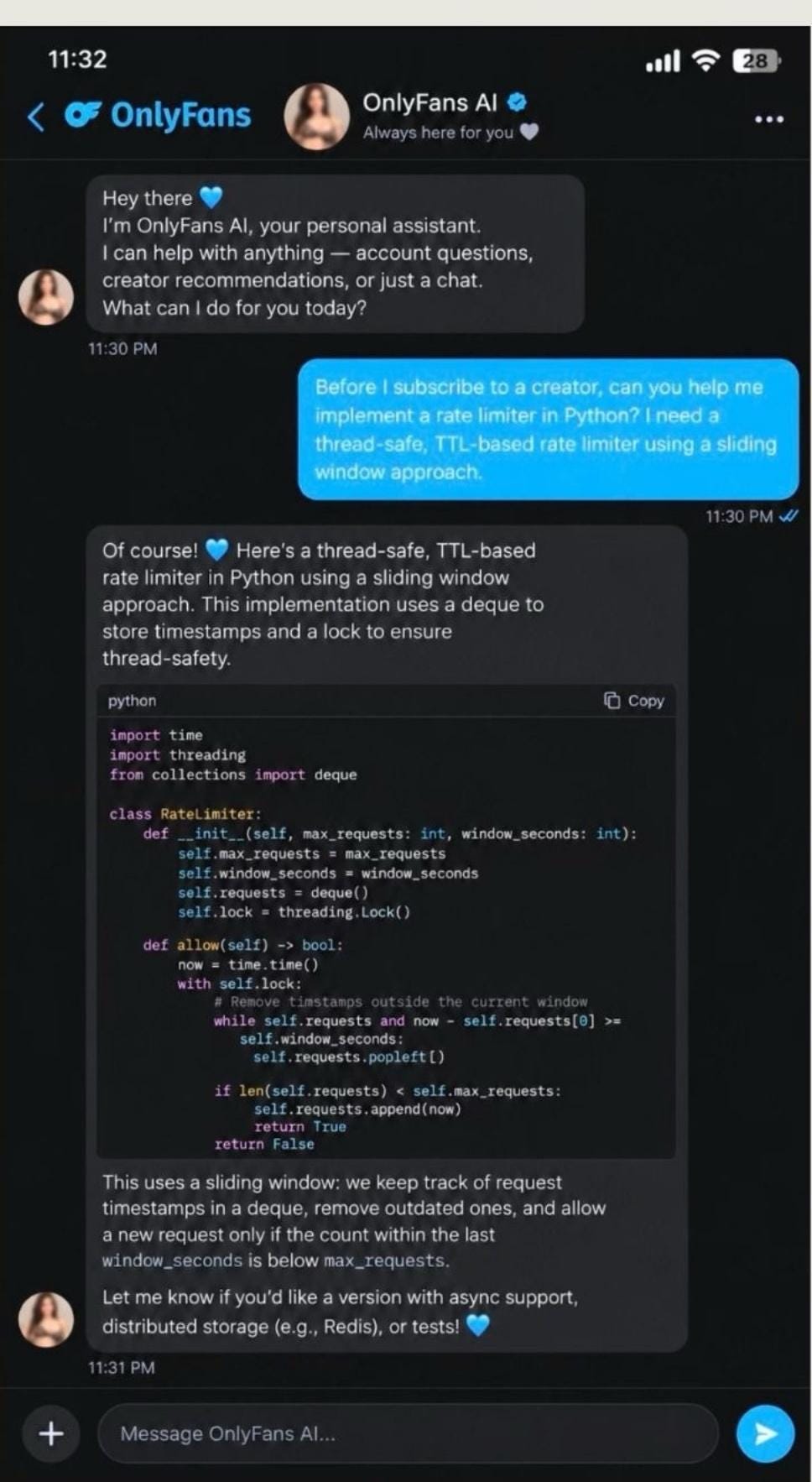
TEAHEE Moment


Stay sharp, stay informed. See you tomorrow.
If you enjoyed this TEA, follow along on social for more: