

Walmart's Agent Gateway, the internet's very bad security day, INSEAD on AI and critical thinking, a professor says shut down business schools, and Samsung and SK Hynix upgrade China fabs
Hello, dear TEA-mates! Here is what you need to know today.
1. 🛒 Walmart Opens an Agent Gateway While Amazon Blocks AI Shoppers
Walmart announced on Wednesday an Agent Gateway, a new MCP server that lets approved AI agents search Walmart and Sam's Club inventory and buy on a shopper's behalf, shortly after Amazon began blocking AI agents from purchasing on its site. CEO John Furner unveiled the plan at the Masters of Scale Summit in San Francisco. Walmart already partners with Meta's Muse agent and integrates with ChatGPT and Gemini. Starting next month, Agent Profiles will let customers authorize each agent separately inside their Walmart account, view agent purchases apart from their own, and either approve every transaction or set a spending cap, similar to adding an authorized user on a credit card. The gateway lets agents shop a customer's usual brands without sharing personal data or purchase history with the agent. New agent terms say agents cannot access payment information, cannot act beyond the shopper's intent, and will be blocked if they break the rules, while Walmart's returns policy still applies when an agent misbehaves. No Walmart+ membership is required. (Read More)
🫖 TEA For Thought: "This might be Walmart's greatest comeback. An AI gateway for all businesses is the future. Literally, it might be 'join or die.'"
2. 🔓 The Internet Is Having a Very Bad Cybersecurity Day
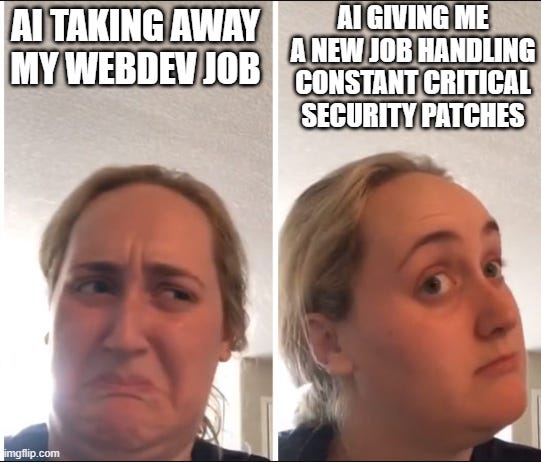
Government websites around the world went offline on Wednesday after AI tools from OpenAI and Google's Wiz uncovered critical, long-standing vulnerabilities in PHP, and the US National Security Agency advised organizations to update immediately or take PHP systems offline until they could. The same day, Node.js patched four high-severity flaws, including one allowing remote code execution and two permitting a TLS validation bypass. LiteLLM, the open source proxy for routing requests across LLM providers, said an attacker injected malicious code into releases published to PyPI, Docker Hub, and GHCR; the payload included an infostealer targeting cloud, password, and AI service credentials plus a remote access trojan. LiteLLM has pulled the releases and posted remediation steps. Separately, Indian certificate authority eMudhra had private keys compromised, a cleanup some security researchers called bigger than Heartbleed. These followed the TiDB Cloud breach announced Monday, active exploitation of the four Plex2Shell flaws, and a BeyondTrust zero-day exploited since August. (Read More)
🫖 TEA For Thought: "Security will be the moat for all products in the era of AI."
3. 🧠 INSEAD: How to Use AI Without Eroding Critical Thinking
In an INSEAD Knowledge piece adapted from their Harvard Business Review article, Melchior Tamisier-Fayard (ESSEC), Theodoros Evgeniou (INSEAD), and Anne-Laure Fayard (Nova SBE) argue that "cognitive offloading" to chatbots weakens critical thinking, decontextualizes expertise, and produces homogeneous ideas. They propose three moves. First, approach AI Socratically: AstraZeneca's 10-day "Prompt With Me Challenge" drew 1,500 participants and has spread to 50+ teams, and a 24-hour ETH Zurich hackathon with roughly 2,000 participants found that teams given challenging feedback produced a wider range of innovative ideas. Second, pick the right place and time: create AI-free blocks and "gated interfaces" that require users to deposit their own context first, keep entry-level staff doing tasks without AI, and run human-led and AI-heavy teams in parallel (a design consultancy's AI team generated about 1,700 images, but the human-led proposal won). Third, experiment with interfaces beyond chat, such as Google's annotation tool for mathematicians verifying proofs. (Read More)
🫖 TEA For Thought: "You can outsource intelligence, but never understanding."
4. 🎓 A Business School Professor Says It's Time to Shut Them Down
In an October 18 New York Times opinion essay titled "I Teach at a Business School. It's Time to Shut Them Down," Cambridge Judge professor Chris Marquis, who previously taught at Harvard Business School for a decade and at Cornell for six and a half years, argues that MBA programs, unlike law or medical schools, exist mainly to produce high-paid managers focused on profit. He cites research from Nobel laureate Daron Acemoglu suggesting MBA-run firms shift profits from workers to shareholders without growing faster, and says HBS-style case studies oversimplify reality and promote management fads. He proposes replacing MBAs with multidisciplinary programs built around history, democracy, and ecological limits, pointing to the University of Vermont's Sustainable Innovation MBA as a model. Marquis told Poets&Quants the roughly 3,000-word essay drew hundreds of messages from deans and students, that the headline was an editor's choice, and that his real goal is reinvention of curriculum and faculty incentives. He returns to Cornell in January for a chaired professorship. (Read More)
🫖 TEA For Thought: "If the sole goal of business school is to train managers, then in the era of AI, when all the middle managers are eliminated, what's the point? I guess, in essence, AI has been a disruptive, revolutionary force like no other. Everything needs to be rethought through."
5. 💾 Samsung and SK Hynix Upgrade China Plants to Make Advanced Chips
Samsung Electronics and SK Hynix are upgrading their Chinese factories to produce NAND flash memory above 200 layers, four people familiar with the plans told Reuters, to counter fast-growing rival Yangtze Memory Technologies (YMTC) and meet AI demand. Samsung's Xi'an plant, about 40% of its global NAND output, is converting to 286-layer V9 NAND under a project called "Monami," targeting 5,000 wafers a month in December 2026 and 40,000 by December 2027. SK Hynix's Dalian site, acquired with Intel's NAND business in 2021 and now Solidigm's only fab, plans to move from 192 layers to 240 or more and may seek US permission for 300-plus-layer R&D. Per Omdia, YMTC held 38.5% of China's NAND market in Q2, up from 28% in 2025, overtaking Samsung at 33.5%. Both companies must seek annual US licenses to install US-made tools in China, and the Commerce Department said in 2025 it did not intend to grant upgrade licenses. Both firms confirmed upgrades are underway in consultation with Washington; their shares closed about 6% higher. (Read More)
🫖 TEA For Thought: "'Four people familiar with the plans said, aiming to fend off competition from a fast-growing Chinese rival and meet huge AI demand.' This is ridiculous. China is too fast, so let's hurry up and build more advanced fabs in China?"
🛠️ Skill of the Day
The Think-First Gate: Makes the AI hold its answer until you have written your own, so you sharpen your thinking instead of outsourcing it.
Act as a thinking coach, not an answer machine. I am going to give you a question or decision I am working on. Do not answer it yet.

My question: [PASTE YOUR QUESTION OR DECISION HERE]

Step 1: Ask me three short questions that force me to state what I already know, what I am assuming, and what a good answer would need to include. Wait for my replies.
Step 2: Ask me to write my own answer in five sentences or fewer. Wait for it.
Step 3: Only now give your own answer. Keep it the same length as mine.
Step 4: Compare the two side by side: where we agree, where we differ, and one assumption of mine you think is weakest. Point to specific sentences.
Step 5: End with one question I should go verify with a real source before deciding.

Rules: never skip ahead to Step 3, even if I ask you to. Plain language. No praise, just the comparison.
Paste into ChatGPT, Claude, or your tool of choice. Replace the bracketed bit with the thing you are actually trying to decide.
TEAHEE Moment


Stay sharp, stay informed. See you tomorrow.
If you enjoyed this TEA, follow along on social for more: