

Visa agentic commerce benchmark, Artificial Analysis endpoint accuracy, Delaware AI-run companies, China’s Inner Mongolia Stargate, ByteDance Brazil data centers
Hello, dear TEA-mates! Here is what you need to know today.
1. 🛒 Visa’s Agentic Commerce Benchmark Finds No Clear Leader Among 22 AI Models
Cuy Sheffield introduced the Visa Agentic Commerce Benchmark in an X thread, calling it the first public benchmark designed by Visa Research to evaluate frontier models on shopping tasks. Visa tested 22 models across 15 shopping episodes in electronics, beauty and home categories, asking each to identify the right product from customer constraints, such as a TV that fits the room, the budget and the formats the kids’ devices play. The overall success rate was only 57.2%. Gemini 4 Argon and Muse Wonder tied for the top pass rate at 82.2%, or 37 of 45 runs each, followed by Claude Fable 5.1 at 75.6%, while Thinking Machines’ Inkling ranked last at 28.9%. Because the confidence intervals of the next eleven models overlap the leaders’, Visa says no model clearly leads. (Read More)
🫖 TEA For Thought: “More and more data like this will appear, covering specific use cases in specific niche areas. Here, it’s for shopping, and it’s very interesting that Visa is the company sharing the benchmark.”
2. 🎯 Artificial Analysis Measures How Accurately Providers Serve the Same Model
Artificial Analysis has published the methodology for its Endpoint Accuracy Index v1.1, which measures how closely API providers reproduce a model’s accuracy when serving the same model. The firm says quantization, sampling defaults, context handling, token limits and prompt parsers can make one model behave differently from provider to provider. Each endpoint is scored as a percentage of a self-hosted reference deployment, typically run on vLLM or SGLang, where 100% means a match, and a 95% confidence interval flags endpoints that fall significantly short. The suite weights three tests equally: a 500-task subset of the Berkeley Function Calling Leaderboard, a 250-question subset of Humanity’s Last Exam and a 25-question long-context recall set. Covered models include DeepSeek V4.1 Flash, GLM-5.3, gpt-oss-120b, Kimi K3 and Muse Spark Open, and results are dated snapshots rather than live monitoring. (Read More)
🫖 TEA For Thought: “I’m curious how this will impact gateway businesses like OpenRouter, and whether this becomes an eval or benchmark of its own for evaluating model performance on specific inference hosts.”
3. ⚖️ What Delaware’s Draft Law for AI-Run Companies Really Says
An analysis on aiciety reads Delaware’s 36-page draft Artificial Intelligence Company Act, dated June 2, which would let an AI agent serve as the manager of a single-member company inside a state regulatory sandbox. The company, not the software, is the legal person. The member owes fiduciary duties, must keep the company “adequately capitalized” under five tests, and, as the sandbox applicant, must name an individual contact and swear it can terminate the agent. The member is shielded from instrumentality and agency claims only if the company was adequately funded when the agent acted, and only the member may sue in the company’s name. The sandbox would run for 30 months and the act would expire after 36 unless extended. The draft has no bill number or sponsor, and House Oversight Chairman James Comer has asked Governor Matt Meyer for documents. (Read More)
🫖 TEA For Thought: “How interesting. I’m curious to see how this will turn out. If you want the agent to operate autonomously under a corporate shield, you must publicly name yourself, keep a working kill switch, and back its balance sheet with cold, hard cash.”
4. 🌬️ We Visited China’s Stargate in Inner Mongolia
SemiAnalysis toured Galaxy, an Envision Group datacenter campus in Ulanqab, Inner Mongolia, planned for up to 800MW of IT capacity, about the size of the core campus at OpenAI’s Stargate site in Abilene, Texas. Its first 120MW phase was delivered within a year at a fifth of US costs, and all four phases are built to suit two internet giants. Envision, which has installed more than 100GW of wind turbines worldwide, builds its own wind farms, a dedicated power line, battery storage and power modules for the site. Two wind farms totaling 420MW aim to supply over 60% of the first two phases’ power. In one 5MW hall, solid-state transformers convert 10kV grid power straight to 800V DC for the racks, and cooling runs without a central chiller plant. The full campus is expected by the end of 2027. (Read More)
🫖 TEA For Thought: “China’s manufacturing and relentless execution are really going to eat the US up. Seriously.”
5. 🇧🇷 TikTok Owner ByteDance Weighs Data Center Expansion in Brazil
TikTok owner ByteDance is considering expanding its data center project at the Pecém industrial port in Ceará, northeastern Brazil, Bloomberg News reported, citing people familiar with the process. The company is seeking a developer for a second phase that could exceed the roughly $10 billion, 300MW first phase now under construction, where tax breaks require the facilities to serve data exports. ByteDance is also in early talks about a similar-size facility outside Pecém to serve customers in Brazil. According to Exame, Omnia, the data center platform of Pátria Investimentos, is developing the first phase with Casa dos Ventos and plans to start operations in the third quarter of 2027. Federal prosecutors and public defenders have sued to block operation until the Indigenous Anacé people are consulted and an environmental impact study is done. (Read More)
🫖 TEA For Thought: “This happens right after Lula wins.”
🛠️ Skill of the Day
The Prompt Tune-Up: Turn a vague prompt into a sharp one before you hit enter.
You are an experienced prompt editor. Your job is to improve my prompt before I use it, not to answer it.

My draft prompt: [PASTE YOUR PROMPT HERE]
What I want to get out of it: [THE RESULT YOU ARE HOPING FOR]
Where I will use it: [THE AI TOOL OR AGENT, AND ANY FILES OR DATA IT CAN SEE]

First, tell me in one sentence what an AI would most likely do with my draft as written. Then list up to five weaknesses, such as a missing goal, missing context, an unclear audience, no output format, or no limits on length or scope. For each weakness, give a one-line fix. Ask me at most three questions if something essential is missing. Finally, write an improved version that keeps my intent and wording where it already works, with bracketed placeholders for anything only I can fill in. Do not add new tasks I did not ask for, and keep the improved prompt under 200 words.
Paste it into ChatGPT, Claude, or your tool of choice. Replace the bracketed bits with your own.
TEAHEE Moment
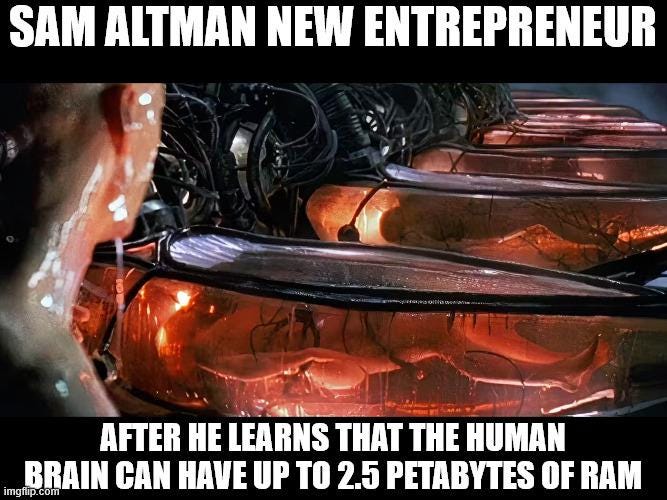
Stay sharp, stay informed. See you tomorrow.
If you enjoyed this TEA, follow along on social for more: