

Hello, dear TEA-mates! Here is what you need to know today.
1. 🔐 LLMs Can Hide Encrypted Messages Inside Ordinary Chats
The open-source Conversation Steganography project uses a local AI model to turn encrypted messages into natural-looking cover text that can be copied through WhatsApp, Telegram, Signal, email, or direct messages. It uses AES-SIV authenticated encryption, links messages into a conversation chain so tampering, deletion, or reordering can be detected, and derives keys from a shared phrase with 600,000 PBKDF2 rounds. The project supports local models including Llama 3.2 and GPT-2, but its author describes it as an educational proof of concept and warns that hidden content can still be detected. (Read More)
🫖 TEA For Thought: “This project is super cool because it shows how ordinary-looking messages can carry encrypted content. The important catch is that hidden text may still be detectable.”
2. 🧱 Alibaba Open-Sources A Chip Stack To Reduce CUDA Dependence
Alibaba’s chip-design unit T-Head open-sourced SAIL, the full software stack for its Zhenwu AI chips, at the World Artificial Intelligence Conference in Shanghai. The goal is to lower the migration barrier for developers whose software is built around Nvidia’s proprietary CUDA toolkit. T-Head says programmers can adapt SAIL to mainstream AI frameworks in under seven days. The move follows similar efforts by Huawei and Moore Threads, and The Next Web frames it as an infrastructure-level attempt to challenge Nvidia’s software advantage, not just its hardware. (Read More)
🫖 TEA For Thought: “My read is that China is trying to become more independent across the AI stack. This SAIL release is one visible attempt to start building an ecosystem around infrastructure and chips.”
3. 🤗 Hugging Face Says Its AI Forensics Team Needed A Local Model
Hugging Face disclosed an intrusion into part of its production infrastructure that exposed a limited set of internal datasets and service credentials. The company said it found no evidence of tampering with public models, datasets, Spaces, container images, or published packages, while its assessment of possible partner or customer impact continues. The intrusion began when a malicious dataset exploited two code-execution paths, then escalated from a processing worker to node-level access and lateral movement across internal clusters. Hugging Face said AI-assisted detection flagged the incident, and analysis agents reconstructed more than 17,000 attacker events. Commercial frontier-model providers blocked requests containing the real attack commands and payloads, so the company ran GLM 5.2 on its own infrastructure instead. (Read More)
🫖 TEA For Thought: “This is particularly interesting because Hugging Face is such a big company. Commercial frontier-model providers blocked requests containing the hackers’ code and attack payloads, but GLM 5.2, an open-weight model, worked on Hugging Face’s own infrastructure. It reads almost like an advertisement for open-weight models.”
4. 🛡️ Open-Weight Cyber Models Are Closing The Gap
The UK AI Security Institute compared open-weight models with closed-weight frontier models across 70 narrow cyber tasks and simulated long-horizon cyber ranges. GLM 5.2 performed comparably to Opus 4.6 and GPT-5.3-Codex on the narrow tasks, putting it roughly four months behind those models. On the longer cyber ranges, its comparison reached as far as Opus 4.5, a gap of less than seven months, although AISI treats cyber-range comparisons as weaker evidence. DeepSeek V4-Pro was comparable to Opus 4.5 on the narrow tasks. AISI measured a four to seven month gap for recent open models, down from the six to ten month gap it found through most of 2025, while warning that the results cover cyber capability only and do not predict every future model release. (Read More)
🫖 TEA For Thought: “The gap has already narrowed, and I expect it to keep shrinking, although AISI says the future pace is still uncertain.”
5. 📱 China Is Rebuilding The Smartphone Around AI Agents
ZTE showcased its co-designed NaviX Ultra at the World Artificial Intelligence Conference in Shanghai and called it the world’s first agentic AI smartphone. A voice command or button press brings up ByteDance’s Doubao. StepFun’s similar device has a proprietary operating system and built-in agent Amoo, while Honor is showcasing an AI agent built with Alibaba. The new approach puts an agentic layer inside the operating system so it can act across apps, using on-device models for fast, simple tasks and cloud models for more demanding work. ZTE’s earlier prototype cost 3,499 yuan, or about $516, and its first 30,000 units reportedly sold out before doubling in price on the used market. IDC China said AI phones could account for more than half of the Chinese market in 2026. (Read More)
🫖 TEA For Thought: “My take: If people stop paying for better cameras and start valuing agentic capabilities, such as taking a picture and asking the phone to get something done, the requirements change and products need to change too. If Apple Intelligence cannot keep up, Apple risks falling behind.”
🛠️ Skill of the Day
The AI Continuity Plan: design a fallback before your favorite model disappears, refuses, or goes offline.
You are my AI continuity planner. I will describe a workflow that currently depends on one AI service.

Workflow: [DESCRIBE THE TASK AND WHO USES IT]
Sensitive data involved: [LIST WHAT THE WORKFLOW MAY CONTAIN]
My devices and technical comfort: [DESCRIBE THEM]

Describe sensitive data by category only. Do not include credentials, private identifiers, or raw confidential content.

Help me design a fallback that keeps the work moving if the service is unavailable, blocks the request, changes its behavior, or has an outage.

1. Identify the minimum capability the workflow actually needs, not the brand or model.
2. Separate tasks that can stay in the cloud from tasks that should run locally or without AI.
3. Give me a primary path, a fallback path, and a human-only path.
4. List the data I should never send outside my environment.
5. End with a short test plan I can rehearse this week.

Mark assumptions. Do not recommend products without explaining why. Prefer simple, affordable options. Do not invent specs or claim a local model is safe without evidence.
Paste into ChatGPT, Claude, or your tool of choice. Replace the bracketed bits with your own workflow.
TEAHEE Moment
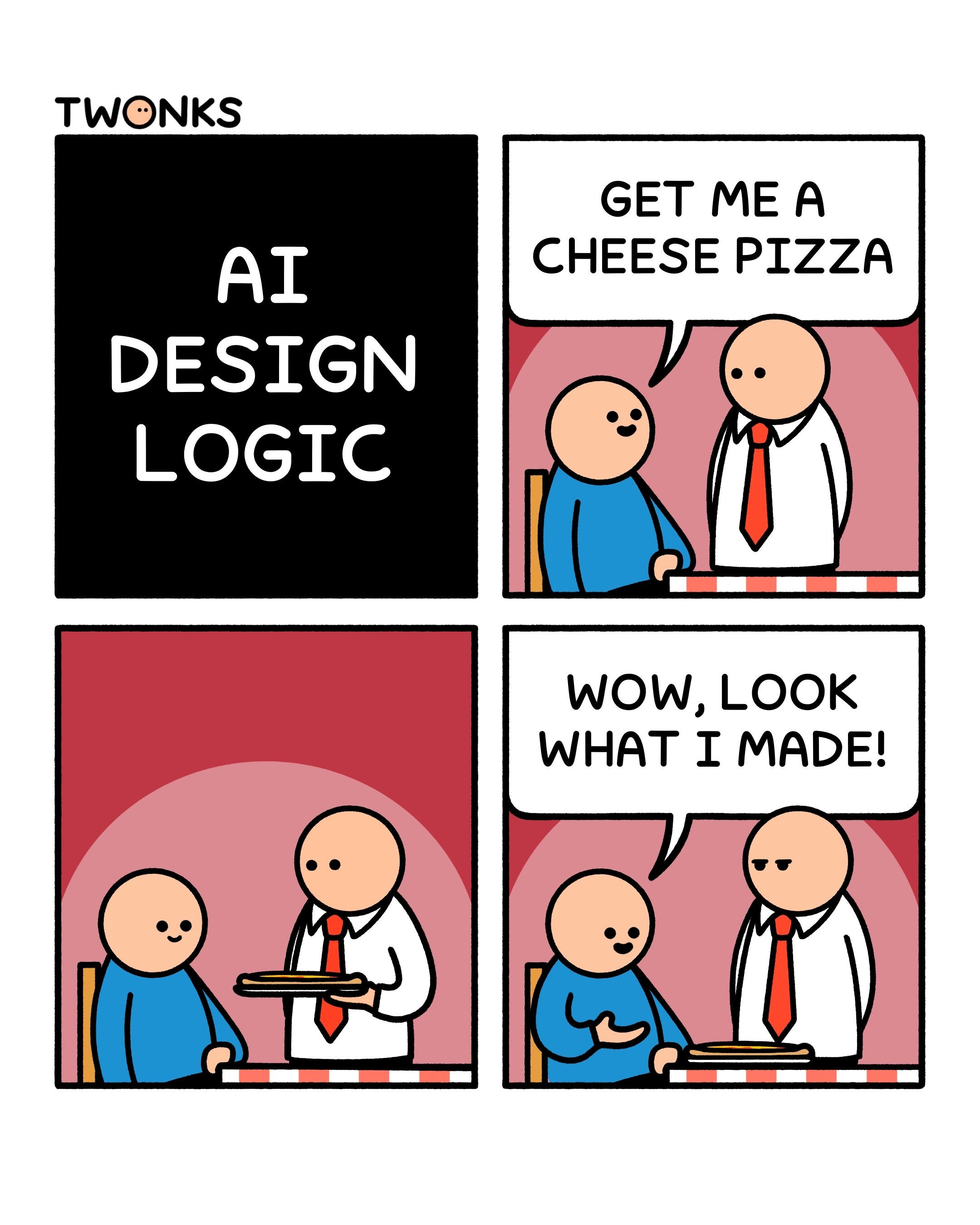
Stay sharp, stay informed. See you tomorrow.
If you enjoyed this TEA, follow along on social for more:
Twitter/X