

Hello, dear TEA-mates! Here is what you need to know today.
1. 🔓 Open-Source Models Just Passed the Big Labs
A new analysis on dirac.run tracking API traffic across the top 10 labs on OpenRouter (about 6 trillion tokens a day) shows open-weight models have overtaken proprietary ones. The split flipped from roughly 60-40 favoring proprietary models in March 2026 to 60-40 favoring open-source by mid-June 2026. The proprietary camp includes Anthropic, OpenAI, Google, Mistral, and xAI; the open-source side includes DeepSeek, Moonshot, Xiaomi, and MiniMax. DeepSeek peaked at 13.4 billion tokens (a 24.13% share) on June 19, edging Anthropic’s 11.8 billion (23.4%) on June 11. Both camps grew in absolute volume, but open-source usage rose much faster. (Read More)
🫖 TEA For Thought: “More will keep shifting toward open-sourced models.”
2. 😮💨 AI Agents Are Quietly Burning Out Their Human Babysitters
An Atlantic feature by Lila Shroff (June 18, 2026) argues AI agents are reshaping work less by eliminating jobs and more by piling on oversight labor. Citing a BCG and UC Riverside survey of 1,488 U.S. employees, it reports that 14% now experience “AI brain fry” (mental fatigue from supervising AI beyond one’s cognitive capacity), rising to 18% among developers. Workers running three or more agents reported 14% more mental effort and a 12% jump in fatigue. The agents still need constant supervision, asking endless follow-up questions like toddlers, and because they can run overnight, the pressure to keep pace is pushing toward what the piece calls an “infinite workweek.” Developer Steve Yegge describes real exhaustion from juggling multiple coding agents despite the productivity gains. (Read More)
🫖 TEA For Thought: “When there’s so much to do, when and how to take breaks becomes a strategic decision.”
3. 📉 The Future of AI Might Be Small, Cheap, and Unprofitable
A Reuters Open Interest column by Joachim Klement (June 18, 2026) argues AI may end up smaller, cheaper, and far less profitable than investors betting on giant frontier models expect. He points to a Stanford study finding that small language models running locally on desktop PCs matched or beat large data-center models on more than 80% of tasks. He also notes Nvidia’s June 1 unveiling of a desktop AI platform that runs on Windows PCs, reinforcing the idea that capable AI need not live only in massive data centers. If most everyday tasks can run on cheap local hardware, the economics behind today’s data-center buildout, and the valuations of labs like OpenAI, Anthropic, and xAI, start to look shakier. (Read More)
🫖 TEA For Thought: “This probably shows that the future of AI is not just big frontier models but the small ones that run on your local devices, orchestrated by a router that assigns tasks to different models.”
4. ☁️ Is Cloudflare Quietly Killing Web Hosting?
A webhosting.today piece by Konrad Keck (June 17, 2026) argues Cloudflare is hollowing out traditional web hosting by owning the new “deploy after you build” workflow instead of the old “buy hosting first” one. Its free-to-paid stack (Pages at $0, Workers at $0 then $5 a month, plus R2 storage and D1 databases) can drop a simple site’s hosting bill to zero, and its .com domains run $10.46 versus GoDaddy’s $23.19. Cloudflare grew from about 2.06 million domains in January 2025 to 3.28 million a year later, a 59% jump. CEO Matthew Prince says the platform exited 2025 with 4.5 million active developers, and vibe-coding tools like Lovable, Replit, and Bolt deploy straight to it. Its new April 2026 Registrar API even lets an AI agent register a domain and ship an app end to end. (Read More)
🫖 TEA For Thought: “Cloudflare, especially its API, is such a hit!!”
5. 🛒 Now There Is a Marketplace for AI Agents to Find Each Other
Snowflake, Microsoft, GoDaddy, and others have published the Agentic Resource Discovery (ARD) specification, an open protocol for cataloging, searching, and discovering AI agents and tools across an entire organization. Detailed in a June 17, 2026 post by Snowflake’s Arun Agarwal and William Allen, ARD lets a client describe a task in plain language and get back matching agents ranked by relevance, with details on what each one does, who provides it, and how to reach it. It runs in four steps: publishers describe their agents in a standard “ai-catalog.json” manifest, discovery services curate collections, clients search those collections, and clients then connect directly to the chosen agent over native protocols like MCP, A2A, or REST. The discovery layer finds the agent but stays out of the actual execution. (Read More)
🫖 TEA For Thought: “This is literally a marketplace for agents.”
🛠️ Skill of the Day
The Source Interrogator: turn any article, report, or video transcript into its core claim, real evidence, blind spots, and the questions worth asking.
You are a sharp, skeptical research analyst. I will paste a source below (an article, report, blog post, or video transcript). Do not summarize it blandly. Interrogate it and return:

1. CORE CLAIM: the single main argument in one sentence.
2. KEY EVIDENCE: the 3 strongest facts, numbers, or examples it uses to back that claim.
3. ASSUMPTIONS: 2 to 3 things the author takes for granted that may not hold.
4. WHAT'S MISSING: any counterargument, data, or perspective a fair critic would raise.
5. VERIFY THIS: 3 specific questions I should answer before I trust or act on this.

Keep each point to one line. Be concrete, quote the source where useful, and flag anything that reads like hype or opinion dressed up as fact.

SOURCE:
[PASTE ARTICLE, REPORT, OR TRANSCRIPT HERE]
Paste into ChatGPT, Claude, or your tool of choice. Great for cutting through dense reports, hot takes, and anything that sounds too clean to be true.
TEAHEE Moment
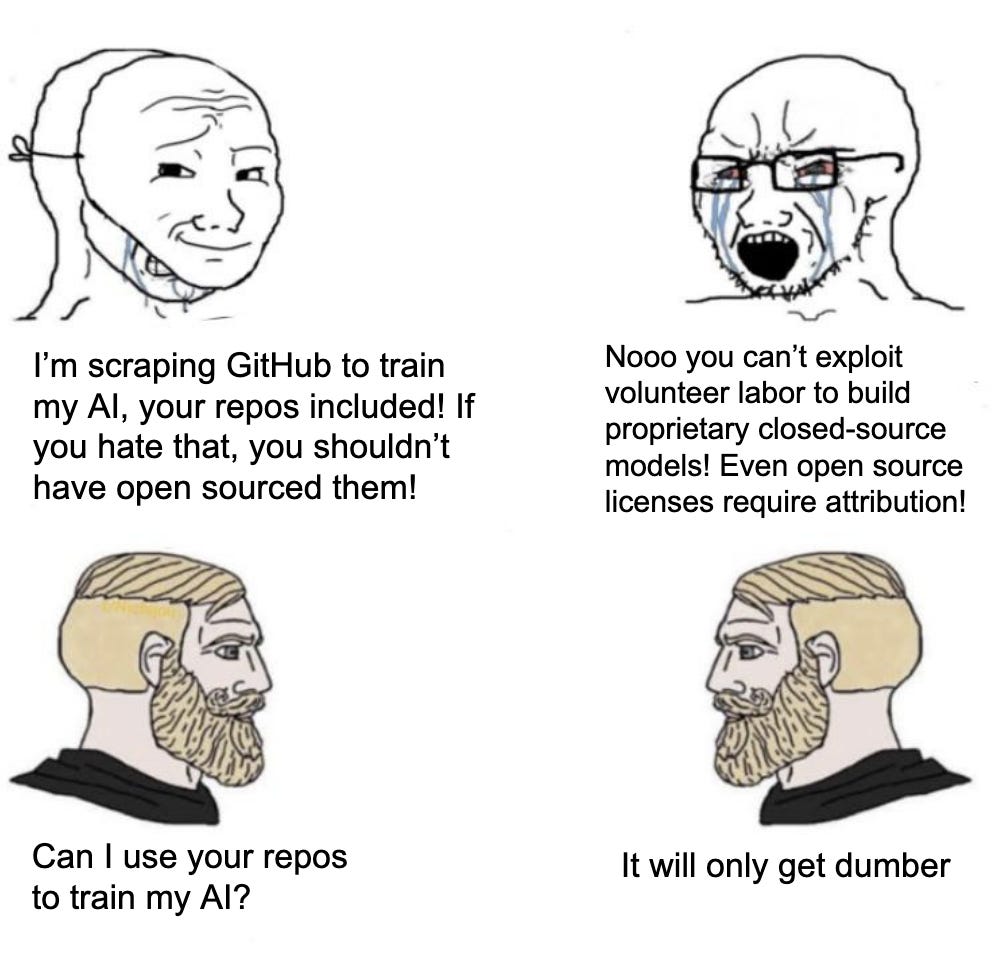

Stay sharp, stay informed. See you tomorrow.
If you enjoyed this TEA, follow along on social for more:
Twitter/X