

Hello, dear TEA-mates! Here is what you need to know today.
1. 💳 Cloudflare Gives AI Agents an Identity and a Wallet
Cloudflare announced Cloudflare Wallets and cloudflare.pay on August 4, giving AI agents deployed on its network a stable identity plus the ability to buy things within limits their owners set. Every Cloudflare account gets a unique web address that works as an ID, and owners can extend that identity to specific agents, so a business receiving a request can see exactly who authorized it. An Account Wallet receives, holds, and manages stablecoins, and owners can issue Virtual Wallets to individual agents with a spending cap, an approved merchant list, and a maximum transaction size the agent cannot exceed on its own. CEO Matthew Prince framed it as giving agents a face, a link back to the human or organization that owns them. Handle reservation opens now, with full access including onramping, offramping, and issuing Virtual Wallets in the coming months. Paired with Cloudflare's Monetization Gateway, the company says both sides of an agentic payment market are now covered. (Read More)
🫖 TEA For Thought: "Cloudflare is clearly expanding its business roadmap, and now it is moving into agent payments. That is the future, if not the only future that is coming."
2. 🧪 TikTok Kept a Safety Fix From Millions to See If It Hurt Engagement
A confidential internal TikTok document, marked privileged and confidential and currently under court-ordered seal, shows that when TikTok adjusted its algorithm in 2021 to stop users from being overwhelmed with harmful content, it did not ship the safer version to everyone. To test whether the change would reduce the app's stickiness, the company held back a control group of 10% of US users, roughly 15 million people at the time, who kept the old version. According to the document, that group included Chase Nasca, a 16-year-old whose feed served him thousands of videos about suicide, sadness, hopelessness and loneliness, right up until he took his own life. The document states that TikTok's filter bubble prevention strategies did not take effect on this user by design. (Read More)
🫖 TEA For Thought: "When an algorithm can make or break a person, and lives are involved, where does the boundary get drawn? The sad thing is that most of the people the algorithm does not physically kill may already be brainwashed or brain rotted."
3. 🧠 Letting a Model Claim Consciousness Makes It Answer More Like a Human
A paper posted to arXiv on July 30 by a team including Junsol Kim argues that safety fine-tuning aimed at stopping language models from attributing consciousness to themselves has effects far beyond that goal. The authors find the same training suppresses a model's tendency to attribute minds to non-human animals and natural objects, and drives down expressed spiritual belief. Two interventions reverse it: ablating the learned safety-refusal direction, and mechanistically steering a consciousness vector in activation space. With those internal representations restored, models attribute mind more broadly and answer standardized sociological surveys on religiosity, moral values, hope, and subjective well-being significantly more like humans do. The authors report that these shifts happen without impairing Theory of Mind, which they say shows core social reasoning stays mechanistically independent. Their stated conclusion is that current safety alignment efforts entangle risky self-attributions of mind with benign spiritual beliefs and with attributions of mind to non-human entities that are culturally widespread. (Read More)
🫖 TEA For Thought: "This paper basically says that when the day comes when everyone has locally hosted models like this at home, a conscious AI, the kind that can feel, act, and experience the way humans do, it could be either a beautiful future or a very ugly one."
4. 📉 Nearly 8 in 10 Finance Firms Expect a 20% Smaller Workforce
PwC surveyed 1,004 director-level and above executives at US financial services firms with at least $500 million in revenue between May 12 and 22, 2026. Nearly eight in ten expect their workforce to shrink by at least 20% over the next five years, with 30% naming entry-level roles as most exposed to AI and 26% naming middle management. Only 42% have done enterprise-wide modeling of how AI changes labor capacity, and among firms with any modeling, just 50% have looked at redesigning processes or workflows. Pay is moving in the other direction: 91% are raising compensation for AI skills, 58% will tie pay directly to AI-enabled productivity, and 86% say AI skills training is more valuable than an MBA for many new hires. The payoff is not landing yet, with 77% saying most AI investments are not delivering measurable ROI, and 90% saying tools used outside centrally governed systems create regulatory risk. (Read More)
🫖 TEA For Thought: "A growing consensus that organizations will likely shrink."
5. 🕸️ Block Is Pooling Idle Laptops Into a Shared Inference Mesh
Block's engineering team detailed the compute sharing feature quietly shipped inside Buzz, powered by the open-source MeshLLM project. The idea is to pool hardware that sits idle, across your own devices, your household, or a Buzz community, and use it for AI inference without sharing the agents themselves. MeshLLM works three ways: one person runs a model and shares it, several models answer the same request and an aggregator combines them in a Mixture-of-Agents setup, or a model is pre-split into layers so each machine downloads only what it needs and the mesh chains the stages into a pipeline. Block says the largest models it has run this way sit at roughly the 500 billion to 1 trillion parameter scale, naming Qwen and Inkling, with throughput depending heavily on the network and on speculative techniques keeping each stage busy. Networking uses Iroh for QUIC-native NAT traversal with encrypted relay fallback. The caveat stated in the post: prompts and data sent to another machine are visible to its owner, so share compute only with people you trust. (Read More)
🫖 TEA For Thought: "MeshLLM runs on the same idea as bitchat, which uses a mesh protocol to let people communicate without the internet, over Bluetooth alone. It is revolutionary, and decentralization is the future."
🛠️ Skill of the Day
The Scope Surgeon: hand it a project you are planning and it cuts it down to the smallest version that still delivers the point, then shows you exactly what it removed and what that costs you.
You are a ruthless scope editor. I will give you a project I am planning. Cut it down to the smallest version that still delivers the core value, then show me exactly what you removed and why.

Project: [DESCRIBE YOUR PROJECT IN A FEW SENTENCES]
The outcome I actually need: [WHAT SUCCESS LOOKS LIKE]
Time, budget, and people I have: [YOUR CONSTRAINTS]

Return four sections:
1. The core. The one outcome everything must serve, in a single sentence.
2. Keep. The 3 to 5 pieces genuinely required to reach that outcome, each with a one-line reason.
3. Cut. Everything else, sorted into "cut for now" and "cut forever", each with what I lose by cutting it.
4. First check. The earliest point I will know whether the trimmed version is working, and what to look at.

Push back if I have handed you a wish list instead of an outcome. Do not add anything new.
Paste into ChatGPT, Claude, or your tool of choice. Replace the bracketed bits with your own.
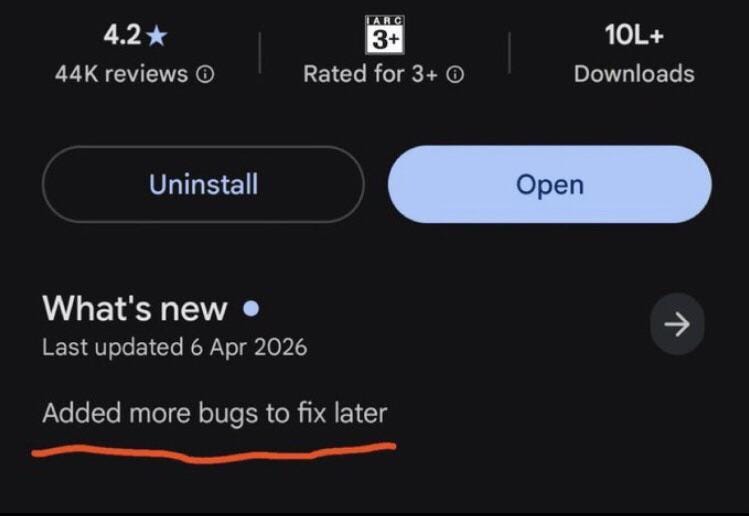
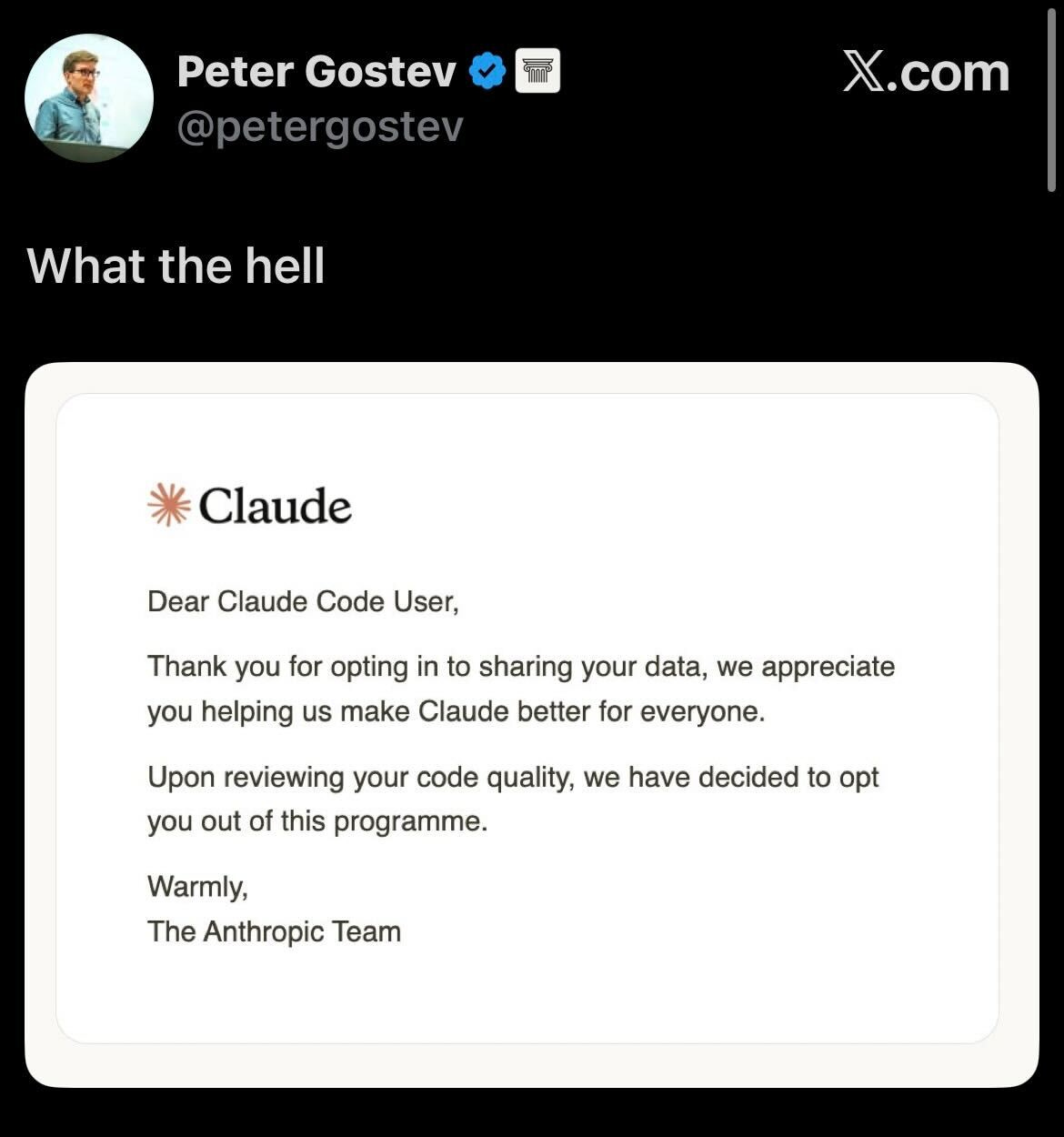
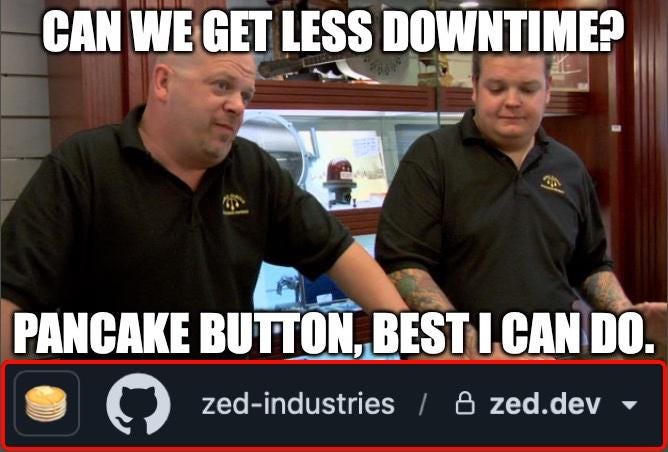
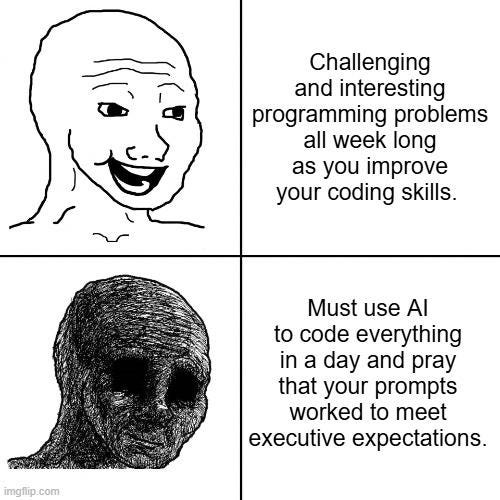
TEAHEE Moment

Stay sharp, stay informed. See you tomorrow.
If you enjoyed this TEA, follow along on social for more: