


Hello, dear TEA-mates—here’s what you need to know today.
1.💬 Amazon’s Alexa+ Jumps From Echo Devices to the Web
Amazon is rolling out a new Alexa.com website so Early Access users of Alexa+ can use its AI assistant directly on the web, alongside a revamped “agent-forward” Alexa mobile app that centers a chatbot-style interface. Alexa+ aims to compete with ChatGPT-style services while leaning on Amazon’s 600 million Alexa-powered devices and a home-and-family focus, from smart home controls and grocery lists to calendars, recipes, and movie-night planning. The assistant now integrates with services like Angi, Expedia, Square, Yelp, Fodor’s, OpenTable, Suno, Ticketmaster, Thumbtack, and Uber, and can manage uploaded documents, emails, and personal information as a hub for family schedules and records. Amazon says over 10 million consumers have access to Alexa+, are holding two to three times more conversations than with the original Alexa, shopping three times more, using recipes five times more, and controlling smart homes 50% more, with opt-out rates in the low single digits and 97% of Alexa devices supporting Alexa+. (Read More)
🫖 TEA For Thought: The installed base of Alexa hardware gives Amazon strong leverage as it enters the AI market; user experience is hard to change, and old habits die hard.
2.🧑💻 Google Engineer Shares 2026 AI Coding Workflow Playbook
Google Chrome engineering leader Addy Osmani lays out a practical AI-assisted coding workflow, showing how developers can use tools like ChatGPT and other models across planning, implementation, debugging, refactoring, and documentation. The approach emphasizes treating AI as a collaborator rather than an autopilot, encouraging developers to break work into smaller prompts, supply clear context, iteratively refine outputs, and maintain human review and testing to avoid subtle bugs and overreliance on generated code. Osmani also highlights patterns like using AI for code search, test generation, performance checks, and knowledge consolidation to help teams ship faster while preserving code quality and maintainability. (Read More)
🫖 TEA For Thought: This is a great reminder for builders in 2026.
3.📎 Plaud Launches AI Pin and Desktop Meeting Notetaker
Plaud has introduced a new AI-powered wearable “pin” and a desktop meeting assistant designed to capture, transcribe, and summarize conversations in real time. The pin is meant to be worn on clothing to continuously record in-person discussions, while the desktop tool focuses on online meetings, with both products aiming to automatically generate notes, action items, and highlights using AI. By combining dedicated hardware with software that plugs into existing workflows, Plaud is targeting professionals and frequent travelers who juggle in-person sessions, client visits, and virtual calls, promising less manual note-taking and better recall of key decisions. (Read More)
🫖 TEA For Thought: This is a compelling model that tightly combines hardware and software, especially for people who meet in person frequently and are always on the go.
4.🤖 Over 60% of Consumers Now Start Daily Tasks With AI
A new PYMNTS Intelligence report finds that more than 60% of U.S. consumers used dedicated AI platforms like ChatGPT, Claude, Gemini, or Perplexity over the past year, signaling that AI has moved into the mainstream. Younger users and “Power Users” are increasingly starting tasks—such as planning, shopping, learning, and decision-making—inside AI systems first, reducing reliance on traditional search, with 42% of heavy AI users saying they now use search engines less. The study also shows that while Light Users remain cautious in high-stakes areas like banking, many consumers are open to linking digital wallets to AI platforms so AI can not only guide decisions but also help complete transactions, shifting the “front door” of online journeys toward AI. (Read More)
🫖 TEA For Thought: Consumers are building comfort, habits, and expectations around AI-mediated journeys; even light users are steadily expanding use for simple tasks, and that momentum is hard to reverse.
5.🏭 China’s Hottest Ticket: EV Factory Tours for Families
In China, factory tours of high-tech manufacturing sites—such as Xiaomi’s electric vehicle plant on the outskirts of Beijing—have become some of the hardest reservations to secure, drawing parents, influencers, and car enthusiasts. Xiaomi’s public lottery for plant visits has attracted more than 100,000 applicants vying for only a few hundred slots, making a tour of its robot-powered assembly lines more competitive than some college admissions. Many parents are bringing children as young as 6 to watch robots, conveyors, and automated systems at work, hoping to spark interest in science, technology, engineering, and mathematics by letting them see advanced manufacturing up close. Other companies, including EV makers, dairy producers, and brewers, are also opening their facilities, as “industrial tourism” grows into a new form of education and leisure. (Read More)
🫖 TEA For Thought: Beyond national pride, these tours let people see with their own eyes how factories operate; just as Johnson & Johnson has a museum, every major tech company should offer spaces where people can see, hear, and understand the culture—powerful marketing with long-term impact.
Prompt Tip of the Day: First Principle Learning
Explain this topic from first principles:
[topic].
Remove jargon.
Focus only on the core ideas I must understand.
TEAHEE Moment


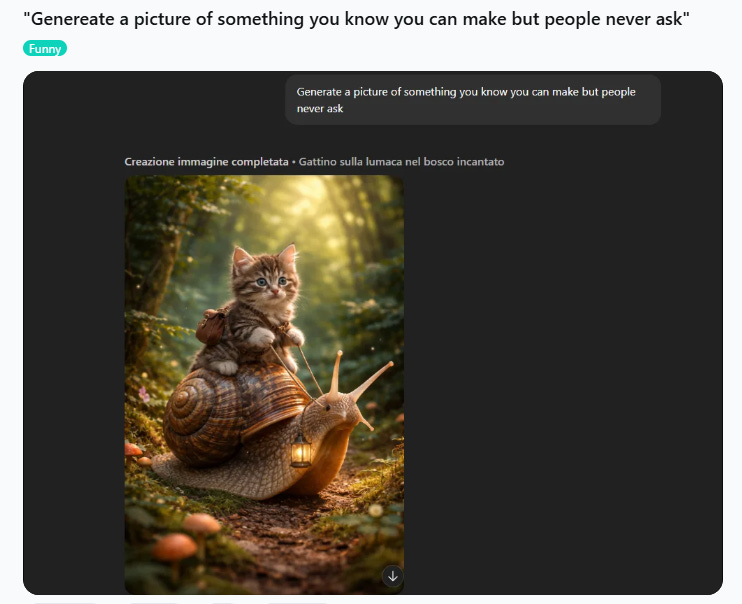
Stay sharp, stay informed. See you tomorrow.
If you enjoyed today’s TEA, follow along on X for more real-time sips of news and threads: Twitter/X.